
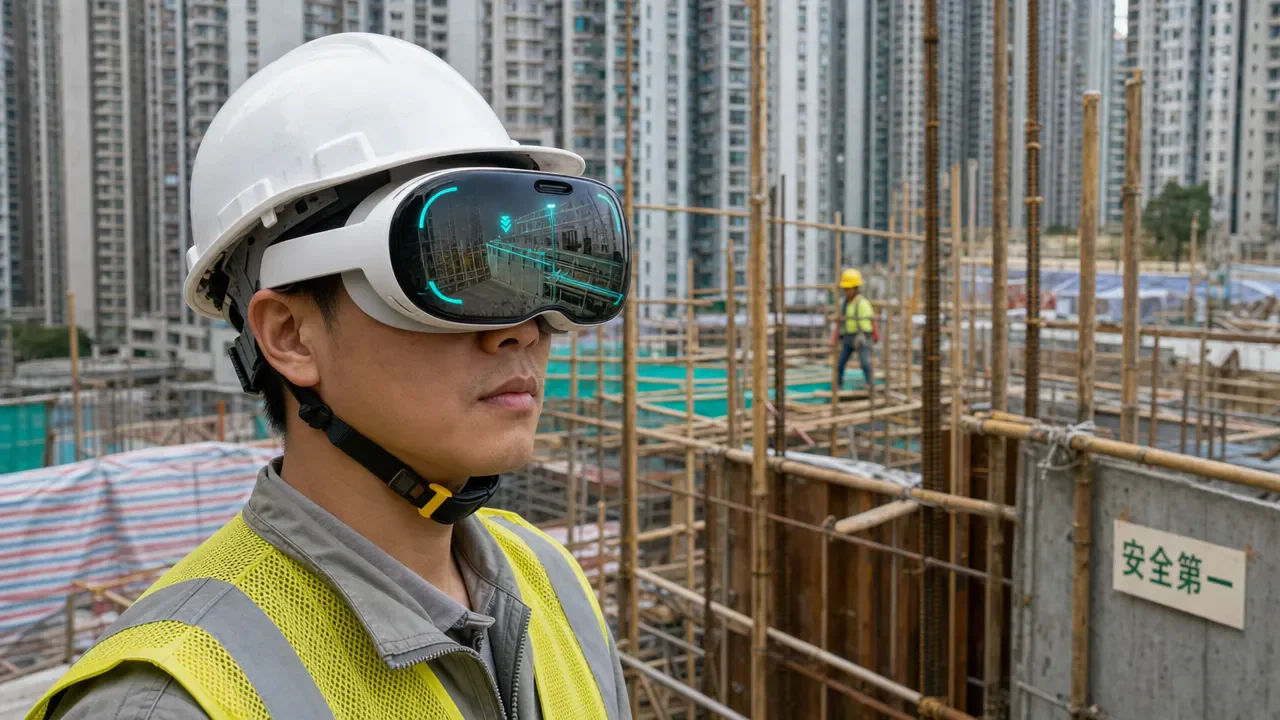
Construction Safety Induction (Green Card) Complete Guide: How CTP VR Replaces Classroom Training and Accelerates Compliance in Hong Kong
Every new worker entering Hong Kong’s construction industry must complete a CIC-accredited safety training programme and obtain a “Safety Green Card” before setting foot on site — this is a statutory requirement, not optional. The traditional approach is a two-day classroom course: hire a venue, engage instructors, wait for the next available cohort, and keep new workers off-site in the meantime. VTM Digital’s CTP VR construction safety training platform delivers immersive VR modules that let workers complete their statutory safety awareness training inside a virtual site environment — reaching compliance faster, reducing holding costs for main contractors, and digitally archiving all training records automatically.
What Is the Safety Green Card System?
The Construction Industry Council (CIC) Safety Training Scheme requires all newly employed construction workers — including skilled workers, non-skilled workers, and supervisors — to complete a CIC-approved safety training course and obtain a Safety Training Card (commonly known as the “Safety Green Card”) before formally commencing site work.
Key facts:
- Who it applies to: All newly employed construction workers, across all trades and role categories
- Renewal cycle: The Safety Training Card must be renewed periodically to ensure workers maintain current safety knowledge and remain compliant
- Approved providers: Training courses and providers must be CIC-accredited to count towards compliance records; non-accredited courses do not count towards the green card requirement
- Legal basis: The Factories and Industrial Undertakings (Safety Officers and Safety Supervisors) Regulations and related construction industry safety ordinances
External references:
- CIC Safety Training information: cic.hk
- Labour Department safety training requirements: labour.gov.hk
Traditional Classroom vs CTP VR New Worker Induction
For main contractors who train large numbers of new workers each year, the difference between the two approaches compounds rapidly at scale:
| Comparison | Traditional Classroom Training | CTP VR Training |
|---|---|---|
| Training schedule | Fixed cohort dates — workers must wait for the next available session | Start immediately, scheduled flexibly around site onboarding pace |
| Venue requirements | Requires a hired classroom or external facility; venue costs form part of training budget | On-site delivery — site office or a temporary space is sufficient |
| Hazard simulation capability | Relies on video or diagrams; workers passively receive information; difficult to realistically recreate high-risk scenarios | Workers directly experience hazard triggers in VR scenes, respond actively, and build behavioural reflexes |
| Compliance record tracking | Manual records, paper-based filing — time-consuming to audit, prone to gaps | Training records auto-uploaded to LMS, organised by worker and module, exportable on demand |
| Reusability | Retraining requires re-scheduling; full cost paid each time | Single licence reused repeatedly; workers can revisit specific hazard drills as needed |
| Cost structure | Venue hire + instructor fees + workers’ wages during standby waiting | Per-seat licence fee; the larger the headcount, the lower the unit cost |
Cost Structure Deep Dive: ROI Framework
The framework below outlines the key cost components of each approach as a reference for procurement decisions (actual figures subject to quotation):
| Cost Item | Traditional Classroom Training | CTP VR Training |
|---|---|---|
| Venue cost | Classroom or external training facility must be booked; cost rises with headcount and number of sessions | No venue cost — existing on-site space is sufficient to get started |
| Instructor cost | Qualified instructors required for each cohort; cost charged per session | No additional instructor headcount required; the VR system guides workers throughout |
| Worker standby waiting cost | While waiting for the next cohort, new workers cannot commence work; the more workers affected, the greater the cumulative standby cost | Same-day start significantly reduces new worker standby time |
| Licence model | Full cost charged for every repeat training | Single licence; the same platform is reused without repeat purchase |
| Economies of scale | As trainee headcount grows, venue and instructor costs increase proportionally | The more workers trained, the lower the per-head licence cost |
CTP Platform-Level Outcomes
CTP is VTM Digital’s VR safety training platform developed for Hong Kong’s construction industry. The following are verified platform-wide figures:
CTP platform-wide outcome
Cumulative training headcount
Live deployments
Covering multiple high-risk trade scenarios
The 83% figure represents the overall platform-wide outcome across the entire CTP platform, not the result of any single module or specific trade. New worker safety induction is one module within the platform; individual site outcomes depend on implementation approach and headcount scale. CTP holds Fire Services Department PA24-072 accreditation, qualifying for government procurement, and is eligible for CITF (Construction Industry Training Fund) subsidies.
Real-World Case: Build King’s On-Site Experience
Build King, one of Hong Kong’s major main contractors, has deployed the CTP VR training platform across its sites. After deployment, the most visible change to the training workflow was in the scheduling and waiting stage: previously, new workers had to wait for the next available classroom cohort (typically several working days), during which they could not formally commence work. With CTP, workers can complete the VR training modules on-site the same day — no longer dependent on external venue scheduling — significantly shortening the time new workers need before reaching compliance and giving project schedules greater flexibility.
MTR is also among Hong Kong organisations that have adopted VR training solutions, reflecting the practical potential of immersive training in large-scale infrastructure environments.
CITF Funding Application: Step-by-Step Guide
The Construction Industry Training Fund (CITF) remains open for applications, with eligible construction industry training expenditure qualifying for subsidies of up to HK$12M+ (subject to project scale and application category). Below is the basic CITF application process:
| Step | Content | How CTP Supports |
|---|---|---|
| 1. Confirm eligibility | Applicant must be a construction industry company; training must fall within CITF-designated fundable categories | CTP qualifies under CITF-approved training categories; VTM can provide accreditation documentation |
| 2. Prepare required documents | Company registration proof, training plan, budget breakdown, list of trainees | VTM can provide training plan templates and course specification documents |
| 3. Confirm maximum subsidy amount | Subject to company size and application category; refer to the latest CIC guidelines for specific caps | VTM’s commercial team can assist in estimating projected subsidy returns |
| 4. Submit application | Submit complete application documents to the Construction Industry Council (CIC) and await approval | VTM can provide documentation and invoices for the purchased CTP solution as supporting evidence |
TVP (Technology Voucher Programme) stopped accepting new applications on 31 December 2024. Construction industry clients should use CITF as the primary funding channel and confirm the latest subsidy rates and caps before procurement.
Frequently Asked Questions
Get New Workers On-Site Faster — and Safer
At its core, the safety green card system exists to protect workers. CTP VR training transforms that protection from passive classroom absorption into muscle memory built by workers personally experiencing hazards, making mistakes, and correcting them inside a virtual site. For main contractors, shortening the time new workers take to reach compliance is not just an efficiency question — it’s a real pressure point on every project programme.
Find out how CTP fits your new worker induction programme
View CTP Solution DetailsFurther Reading
- VTM CTP Construction Safety Training Platform — Full Solution Overview
- CITF Grant for VR Safety Training: The Complete Guide for Hong Kong Construction Companies (2026)
- VR Safety Training for Airport Construction Sites: How Hong Kong Is Closing the Gap Between Statistics and Worker Behaviour
- 3DGS vs Matterport vs LiDAR: HK Scanning Tech Guide | VTM
- Hong Kong XR Construction Safety Training: PA24-072 Accreditation Guide (2026)
- How to Reduce Construction Training Costs with VR: A Practical ROI Guide for Hong Kong
- XR Training for Vocational and Professional Education in Hong Kong: How VPET Institutions Are Adopting VR
Sources:
- Construction Industry Council CIC (cic.hk)
- Labour Department (labour.gov.hk)


