
By VTM Digital | Updated June 2026 | Construction Safety Training
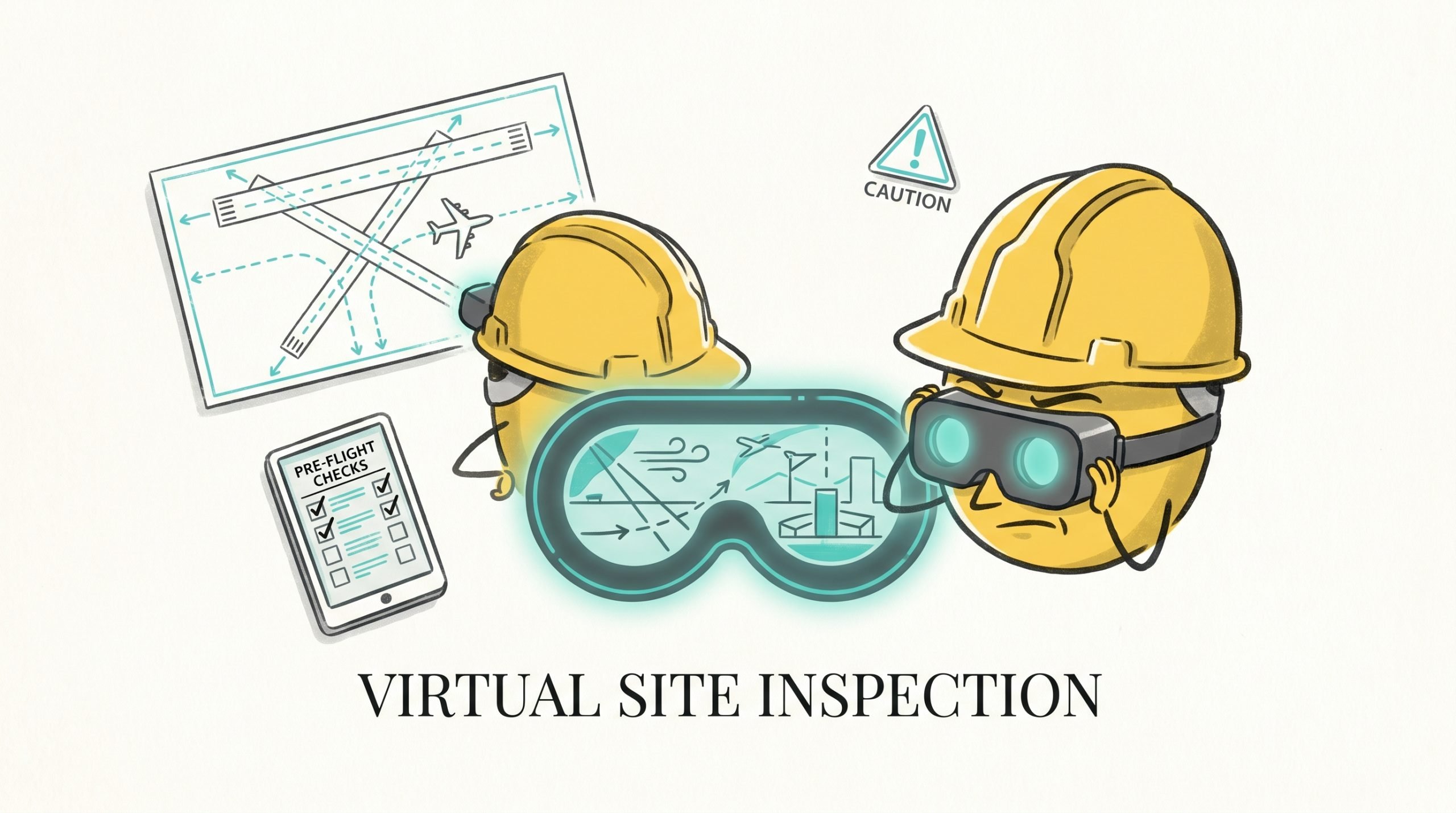
VR safety training reduces construction accident rates by equipping workers with hazard recognition skills before they face real risk — and at Hong Kong’s airport construction sites, where security zones, aviation obstacle constraints, and multi-contractor operations compound the challenge, immersive VR modules are now part of the standard safety architecture. According to the occupational safety research data submitted to Hong Kong’s Legislative Council Manpower Panel in May 2025 (LC Paper CB(4)1190/2024-25(04)), construction accounted for over 60% of all industrial fatalities in Hong Kong in 2024. That number is driving major project owners, including the Airport Authority Hong Kong (AAHK), to specify VR safety training as a contractual requirement rather than a recommendation.
What Is VR Safety Training? Definition and Mechanism
Zero-risk experience of high-risk scenarios
VR construction safety training places workers inside a high-fidelity virtual site using a head-mounted display (HMD). Rather than watching a video or sitting through a lecture, the worker actively navigates hazardous scenarios — work at height falls, entrapment by rotating machinery, confined space entry, electrical proximity — and must make decisions with real-time consequences within the simulation. The result is procedural memory, not passive recall.
Why retention rates are so much higher
Traditional classroom safety briefings achieve an average knowledge retention rate of 10–20% measured 24 hours after training. Immersive VR training, engaging visual, spatial, and motor pathways simultaneously, achieves retention rates above 65% one week later — confirmed by PwC’s 2020 enterprise VR training effectiveness study, the largest study of its kind at that time, covering 1,000 employees across multiple sectors. The PwC 2020 study found VR-trained employees were 275% more confident applying skills on the job and completed training four times faster than in-person classroom equivalents. The UK’s Health and Safety Executive (HSE) has separately documented immersive simulation as an evidence-based tool for procedural risk training, noting its effectiveness in sectors with high fatality rates (HSE Research Report RR1167).
This is not unique to any one geography. Sydney Water’s VR safety programme in Australia, which VTM Digital has documented separately, demonstrated parallel outcomes — faster hazard identification, measurable reductions in near-miss incidents. The mechanism is consistent across industries: embodied simulation beats abstract instruction for procedural safety skills. That is not a theory. It is four decades of cognitive science.
The regulatory environment in Hong Kong is hardening around this. Under DEVB Technical Circular (Works) No. 3/2023, government construction contracts exceeding HK$30 million must deploy the Smart Site Safety System (4S System) across the project. VR safety training functions as the human-factors layer of the 4S ecosystem — moving from “recommended” to standard specification across major public works.
How VR Safety Training Works: Three Layers
Layer 1: Scenario modules
A construction VR safety training platform covers the highest-risk work categories: work at height, excavation and shoring, lifting operations, work near electrical equipment, and confined space entry. Each module is structured across difficulty levels, requiring the worker to actively identify hazard points and make correct decisions — not to observe passively. Wrong decisions trigger realistic visual and audio consequences without physical danger.
Layer 2: Data analytics dashboard
The training platform records every session automatically: pass/fail per module, response time per hazard prompt, error patterns by worker and by trade. Site safety officers access a real-time dashboard showing training compliance across the entire site. When a worker consistently fails a specific module, the system flags it for retraining. On large-scale projects with thousands of workers, this automated compliance tracking replaces what would otherwise require a dedicated administrative team.
Layer 3: Green Card integration
Some VR training platforms now integrate with the Green Card (平安卡) site-access system. A worker completes the required VR training modules and achieves a qualifying score — then and only then receives daily site-access authorisation. Training results are tied directly to access control, not simply filed as paper records. This closes the compliance loop between what a worker has learned and what they are permitted to do on-site. Training leads. Access follows.
| Training Dimension | Traditional Classroom Briefing | VR Immersive Training |
|---|---|---|
| Knowledge retention rate | 10–20% (after 24 hours) | 65%+ (after 7 days) |
| Scenario realism | Low (slides / video) | High (360° immersive) |
| Training record format | Manual sign-in sheets | Automatic digital log |
| Repeat training cost | High (trainer hourly rate × headcount) | Low (near-zero marginal cost) |
| Multi-site deployment | Difficult (trainer must travel) | Flexible (portable device, cloud sync) |
| Green Card integration | Not supported | Available on select platforms |
VR Safety Training at Airport Construction Sites: Four Deployment Steps
Why airport sites demand higher standards
The Third Runway System (3RS) project at Hong Kong International Airport is among the largest construction undertakings in the city’s recent history. The environment presents compounding challenges not found on standard urban sites: airside security zones, aviation obstacle limitation surfaces, multi-contractor interfaces, and round-the-clock operational adjacency. VR training on an airport construction project is not simply a “nice to have” — the site safety plan must account for scenarios that differ meaningfully from city-centre high-rise work.
Based on deployment experience at AAHK-contracted projects using VTM’s CTP (Construction Training Platform), implementation follows four stages:
Step 1 — Hazard scenario customisation. Not all VR modules apply equally to every site. Airport construction introduces specific high-risk scenarios: work at height near runway approach corridors, confined space entry in underground systems, large plant movement near pedestrian routes, and working adjacent to live electrical infrastructure. A qualified VR training provider reviews the site safety plan and selects or fine-tunes relevant modules to match the actual hazard profile of each construction phase.
Step 2 — Equipment deployment and worker onboarding. Standalone VR headsets are positioned in the site welfare facility or training room. The interface requires no prior digital experience — most workers achieve independent operation within ten minutes. Site safety officers require approximately half a day of system training to operate the dashboard.
Step 3 — Training records and monitoring. The site safety officer monitors training compliance through the dashboard in real time: which workers have completed which modules, pass rates by trade, and flagged individuals requiring follow-up. The system auto-generates training reports in formats suitable for submission to project owners, consultants, and Labour Department inspectors.
Step 4 — Refresher and phase-change cycles. VR safety training is not a one-time event. High-risk trades — crane operators, aerial work platform users, confined space entry teams — should complete refresher modules quarterly and at each major phase transition as site hazards evolve. This is a systematic commitment, not a compliance tick-box.
CIC official website →
Performance Data: What the Evidence Shows
The honest picture on VR training ROI
Safety managers evaluating VR training typically raise three questions: Are the numbers real? Do they hold in Hong Kong conditions? What ongoing resource does the system require?
On documented performance: construction sites that have adopted virtual reality training for safety report first-attempt pass rates on high-risk modules of 65–80%. VTM Digital’s 2023 CTP platform analytics study found that workers trained through immersive VR scenarios identified hazards 35% faster than workers in traditional classroom training cohorts — a gap that is consistent across extended reality (XR) training deployments in high-risk industries globally. The Labour Department’s 2024 occupational safety statistics confirm construction remains the most dangerous industry in Hong Kong by fatality proportion — which provides the context for why these gains matter.
The honest limit: VR training is a lever for improving hazard awareness and procedural compliance. It does not substitute for sound site management, equipment maintenance, or organisational safety culture. On the specific question of worker behaviour change, however, the data from multiple Hong Kong projects is consistent and positive.
VTM Digital’s CTP platform is currently active across 60+ sites in Hong Kong, with over 10,000 workers in active training across construction, civil engineering, and building services trades. Learn about the CTP platform →
For industry-wide safety data: Labour Department — Occupational Safety and Health →
When VR Safety Training Is Not the Right Fit
Worth stating plainly: VR safety training is not appropriate for every project. Short-duration contracts under three months, sites with fewer than 50 workers, or projects with only one or two trade types and a straightforward hazard profile may not recover the setup cost within the project lifespan. For those cases, using a shared training facility or booking public courses through the Construction Industry Training Authority (CITA) is more practical and financially sound. VR training’s advantages compound with scale — it is best suited to large, long-duration, multi-trade projects with recurring hazard exposure and a budget for systematic refresher cycles.
Frequently Asked Questions
Ready to Evaluate VR Safety Training for Your Construction Project?
Every site accident represents a training gap that could have been closed. If you are assessing VR safety training for an active project or an upcoming contract — particularly at complex, high-specification sites like airport construction — a direct conversation about your scale, trade mix, and timeline is more useful than any article.
Also explore: PMTP Property Management Training | XR Academy
- Hong Kong Legislative Council Manpower Panel: Analysis of Occupational Safety and Health in Hong Kong 2024 (May 2025)
- Labour Department: Occupational Safety and Health Statistics (2024) — labour.gov.hk
- DEVB Technical Circular (Works) No. 3/2023: Smart Site Safety System — cic.hk
- Construction Innovation and Technology Fund (CITF) — citf.cic.hk
- PwC: The Effectiveness of Virtual Reality Soft Skills Training in the Enterprise (2020)
- VTM Digital CTP platform analytics (2023)


