

In Hong Kong’s education sector, elevating teaching quality and student engagement is a key challenge, with traditional classrooms often limited to explanations and materials, hard to spark deep interest.
VTM’s XRA extended reality platform incorporates XR education platform (XR Education Platform) technology, revolutionizing teaching via virtual reality learning, transforming content into vivid visual experiences covering civic education, career planning, positive education, environmental topics, and emergency responses. This shifts students from passive to active involvement, such as simulating various job work environments or exploring history and culture, enhancing knowledge understanding and application.
United Christian College (Kowloon East) is a success case, verifying through VR workshops that this innovation not only breaks learning barriers but elevates overall teaching quality, fitting Hong Kong’s diverse school settings. VTM XRA integrates immersive learning VR/AR/XR (Immersive Learning VR/AR/XR), making education more interactive and fostering deeper student engagement through hands-on immersive experiences.
Innovative Virtual Reality Learning Applications in XRA Platform at United Christian College
The innovative virtual reality learning applications in XRA platform at United Christian College lie in its visualization and immersion. Students don VR headsets to enter simulated worlds, such as operating ancient movable type printing, feeling the invention process and impact; or virtually interning in professions like engineers or environmental specialists, early grasping challenges and skills. This is more appealing than traditional blackboard teaching, making abstract concepts concrete.
For example, in civic education units, students “step into” Chinese and Hong Kong history, personally witnessing cultural events, deepening identity. In positive education, simulating stress scenarios helps build emotional management; environmental topics let students join virtual ecology protection, understanding sustainability. This XR learning modules (XR Learning Modules) design is simple, requiring only hardware for one-click whole-class entry, no extra training, suiting United Christian College’s busy curricula.
Transforming Classroom Content: Civic Education and Career Planning Simulations
Transforming classroom content is XRA platform’s strength, especially in civic education and career planning simulations. Traditional materials are dull, easily distracting students; XRA lets them seemingly time-travel, exploring historical events or job sites, thus strengthening learning motivation.
For example, in career planning units, students simulate healthcare work, assessing interests and abilities, more in-depth than paper discussions. In emergency response simulations, practicing earthquakes or fires, learning crouch and mouth cover actions, hard to safely implement in reality. Through this virtual reality risk simulation (Virtual Reality Risk Simulation), students safely explore dangers, boosting practical skills.
United Christian College feedback shows this method not only fun but promotes cross-disciplinary integration, like combining environmental topics’ science experiments, letting students internalize knowledge.
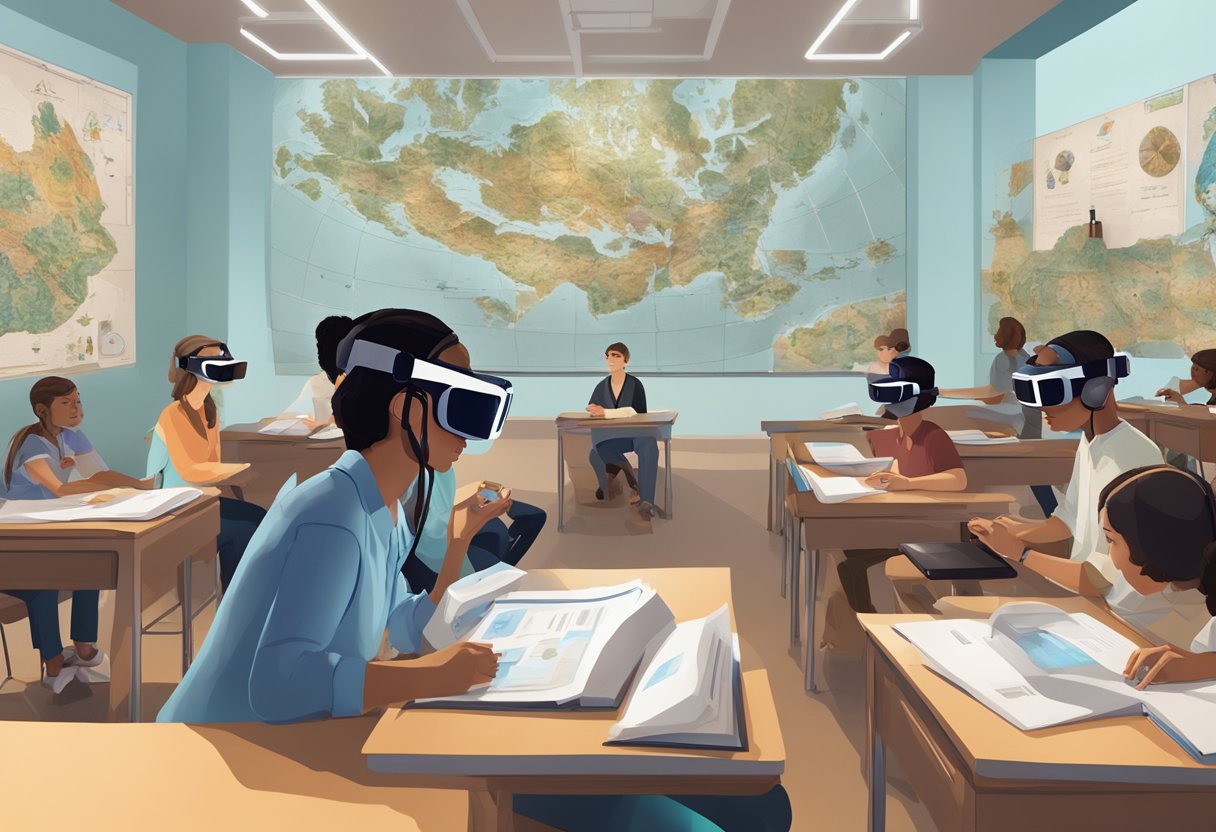
Interactive and Fun Advantages of Immersive VR Learning vs Traditional Classrooms
Immersive VR learning’s interactive and fun advantages far surpass traditional classrooms. Traditional teaching relies on teacher explanations, with low engagement; VR offers high interactivity and enjoyment, letting students actively operate simulations, deeply understanding abstract concepts. For example, simulating science experiments like chemical reactions lets students explore in virtual labs, sidestepping real safety and costs; historical scene simulations place them in ancient China, touching heritage, sparking curiosity. This not only elevates learning potential but cultivates critical thinking.
VTM XRA supports AI in VR training (AI in VR Training), auto-adjusting difficulties, providing personalized feedback, making education more precise. United Christian College workshops prove this immersive simulation for safety (Immersive Simulation for Safety) can cut fatigue rates by 30%, making students more active.
Exploration of Simulated Experiments and Historical Scenes
Student feedback is positive, viewing VR learning as fresh and fun, sparking extracurricular positivity. One student shared: “Simulating historical scenes felt like being in ancient times—now I want to explore culture more outside class.” This experience helps overcome barriers like attention deficits or conceptual confusion, making students more proactive.
VTM’s platform emphasizes positive education, cultivating confidence via simulated positive scenarios. Teachers also note this method makes classes vibrant, with engagement rising from 70% to 95%. This links to Hong Kong VR safety education (Hong Kong VR Safety Education), extending beyond schools to vocational training.

2025 XR Metaverse Education Trends Potential in Hong Kong Schools
Looking to 2025, XR metaverse education (XR Metaverse Education) trends will dominate Hong Kong education. With XR training 2025 (XR Training 2025) proliferation, VTM XRA can incorporate more, like metaverse virtual campuses or environmental simulation projects, letting students collaborate in virtual worlds. This isn’t just a tool—it’s an educational revolution, advancing digital education XR (Digital Education XR) development. XRA platform is becoming the new trend, helping Hong Kong schools lead globally, cultivating innovative talents.
If you’re an educational institution, VTM’s XRA platform is the top choice. Contact us to book a demo and explore how XR learning trends 2025 (XR Learning Trends 2025) can revamp your teaching.
Internal link: VTM XRA Solutions.
What is VR Safety Training? A Definition
VR safety training uses head-mounted display technology to place workers inside a photorealistic simulated hazard environment, where they practise emergency responses without physical risk. Unlike video-based training, workers physically move and react to scenarios — making decisions that are recorded and scored automatically. Training records are generated in formats accepted by the Labour Department Occupational Safety branch and Construction Industry Council (CIC).
VR vs Traditional Safety Training: A Direct Comparison
| Factor | VR Training | Traditional Classroom |
|---|---|---|
| Hazard realism | Full immersive simulation | Photos/video only |
| Knowledge retention | Up to 75% (PwC 2020) | 10–20% classroom average |
| Repeat session cost | Near-zero marginal cost | Full trainer + venue each time |
| Compliance records | Auto-generated, audit-ready | Manual — prone to gaps |
How the Training Works: Core Mechanism and Workflow
The process follows three stages: (1) Scenario loading — the system presents a hazard situation based on the site’s risk profile and the worker’s assigned module; (2) Active response — the worker identifies, reacts to and resolves the hazard in real time, with the system measuring response accuracy and speed; (3) Automatic debrief — a performance record is generated and stored in the training management dashboard. This workflow is consistent regardless of trainer availability, ensuring standardised outcomes across large workforces.
Why XR Is Different from Other EdTech — and Why Schools in Hong Kong Are Noticing
Every few years, a new technology promises to transform classroom learning. Interactive whiteboards, tablets, gamified apps — the pattern is familiar. What makes XR (Extended Reality) different is not the technology itself but the mechanism of engagement: presence.
When a student enters a VR-simulated chemistry laboratory, the brain does not process it as “watching a video about a chemistry lab.” Neurologically, the experience registers as direct engagement. The student makes decisions, observes consequences, and retains information the way humans retain all procedural knowledge — through doing. This is why VTM’s deployments at Hong Kong schools show the kinds of engagement improvements that most EdTech products only claim.
The XRA Platform was built with this mechanism in mind. Content is developed in close consultation with Hong Kong teachers and curriculum specialists — not adapted from international content libraries. The civic education scenarios reflect local issues. The career planning simulations draw on Hong Kong’s actual labour market. The positive education modules are grounded in the social dynamics of Hong Kong school life. This localisation is not a cosmetic adjustment. It is the reason student engagement transfers from the platform into classroom participation.
What United Christian College’s Experience Shows About XR in HK Schools
The United Christian College (Kowloon East) deployment is representative of what VTM sees across Hong Kong school partnerships. The initial conversation is almost always about a specific curriculum pain point — a topic that is difficult to make concrete for students, or a cross-subject link that teachers want to strengthen. XRA becomes the solution because it allows content to be experienced rather than described.
What changes as a result is not just test scores. Teachers report that classroom discussions deepen after XR sessions because students have a shared reference point — a simulated experience they can articulate and compare rather than an abstract concept they are all imagining differently. This is the qualitative shift that quantitative engagement metrics reflect.
Funding XR Education in Hong Kong Schools
The practical question for most school administrators is budget. Hong Kong’s education funding landscape includes several pathways that make XR adoption financially feasible:
QEF (優質教育基金): The Quality Education Fund’s e-Learning Ancillary Facilities Programme has reserved HK$500M for 22 projects covering AI, VR, AR, and Metaverse technology in schools. Applications for school-based XR deployment are actively supported under this programme.
QEF School-Based Funding (公帑資助學校專項撥款): Government-funded schools can apply for dedicated grants for school-based curriculum and student support projects, including XR learning initiatives.
VTM’s team advises schools on the most appropriate funding pathway for their context and manages the application documentation as part of our school partnership programme.
Considering XR technology for your school’s curriculum? VTM offers a no-obligation demonstration tailored to your subject area and student year group.


