

Why APAC VR Training Excels at United XR Europe
European enterprises in construction and facility management are achieving measurably better safety training outcomes by adopting VR training methodologies developed in Hong Kong — not because of novelty, but because Hong Kong’s high-density, high-pressure urban construction environment has pressure-tested these platforms in ways European markets rarely demand. According to Hong Kong’s Labour Department Occupational Safety and Health Branch, construction employers are required to ensure all workers complete relevant safety training before deployment — a compliance standard that drove VTM Digital to develop highly practical, results-first VR training solutions adopted by projects including the Hong Kong International Airport third runway expansion and multiple large-scale government contracts.
According to Hong Kong’s Labour Department Occupational Safety and Health Branch, employers in the construction industry are required to ensure all workers complete relevant safety training before deployment. The Construction Industry Council (CIC) continuously updates approved training standards, which organisations can reference when designing their training programmes.
The Asia-Pacific (APAC) region, particularly Hong Kong, has become a hub for high-intensity construction innovation. At VTM Digital, we have honed our XR training solutions in this demanding environment. We are now bringing these battle-tested platforms to the European stage, bridging the gap between APAC’s operational efficiency and Europe’s strict regulatory standards. This article explores why top engineering firms and contractors are leveraging VTM Digital’s ecosystem to solve their most urgent safety and operational challenges.
The Evolution of Construction VR Training
The construction industry, while often slow to adopt new technologies, faces the highest stakes when it comes to safety and efficiency. Traditional classroom safety briefings are often seen as a procedural checkbox—necessary but not truly effective. This is where construction VR training has transformed the approach to workforce readiness.
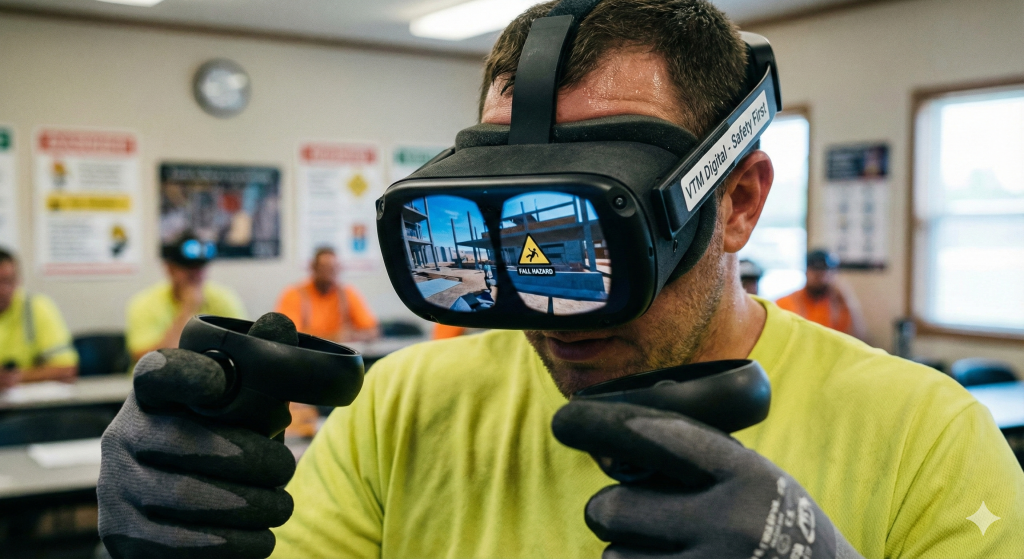
In dense urban environments like Hong Kong, there is zero margin for error on a construction site. VR training for contractors has evolved far beyond simple 360-degree videos. It now involves fully immersive, interactive simulations that allow workers to experience the direct consequences of their actions without facing real-world harm.
Moving Beyond the Classroom
For engineering firms, a major benefit of VR is consistency. A VR training for engineering firms program guarantees that every engineer, site manager, and laborer receives the exact same standard of instruction, overcoming language barriers and geographical separation. At United XR, VTM Digital will demonstrate how our platforms support multilingual deployments. This ensures a safety protocol designed in a European head office is perfectly understood by a contractor on a site anywhere in the world.
The Game Changer: BIM VR Training and Integration
One of the most significant technological advancements VTM Digital is bringing to Brussels is the deep integration of Building Information Modeling (BIM) with Virtual Reality. This combination is a powerful tool for proactive safety management.
From Blueprint to Virtual Reality
BIM VR training allows project stakeholders to step inside a digital twin of a structure before a single foundation is poured. This is more than a visualization tool; it is a critical safety function. By conducting a BIM x VR safety walkthrough, managers can identify and mitigate potential hazards during the architectural design phase, long before they become costly or dangerous on-site problems.
For instance, a site manager can navigate a virtual model of a complex industrial plant. They might notice a critical valve is located in a hard-to-reach area, requiring scaffolding for regular access and creating a recurring fall risk. By identifying this issue in the BIM VR training phase, the design can be altered to move the valve to a safer, more accessible location. This proactive approach transforms safety from a reactive measure into a core design parameter, a philosophy that aligns perfectly with European safety standards.
High-Risk Simulations: Work at Height and Hazard Recognition
Falls from height remain the leading cause of fatalities in the construction industry worldwide. As a result, work at height VR training is one of the most critical modules in our library. Effective training, however, requires more than just showing a worker a virtual ledge.
The Psychology of Height
Our work at height VR training modules are engineered to trigger the physiological responses associated with heights, such as vertigo and an increased heart rate. By acclimating workers to these sensations in a safe, controlled environment, the training helps reduce panic and poor decision-making when faced with a real-world scenario.
Spotting the Invisible
Beyond specific tasks, VR hazard training teaches workers to identify risks that are not immediately obvious. In a VTM simulation, a user might navigate a busy construction site and be tasked with identifying unsecured loads, electrical hazards near water, or colleagues using incorrect PPE. The system tracks their eye movements and reaction times, providing valuable data on whether they genuinely recognized the hazard or simply walked past it.
The Enterprise VR Platform: Scalability and ROI
Implementing these advanced solutions effectively requires more than standalone applications. It demands a robust enterprise VR platform. Chief Technology Officers and Innovation Directors attending United XR Europe are not just looking for content; they are looking for scalable infrastructure.
An enterprise-grade platform must provide:
- Centralized Management: The ability to deploy content and software updates to hundreds of headsets simultaneously.
- User Management: Clear, distinct roles for trainees, trainers, and administrators to manage progress and permissions.
- Hardware Agnosticism: Seamless operation across major hardware like HTC VIVE, Meta Quest, or Pico devices.
As a leader in XR training Hong Kong, VTM Digital has built its platform to meet the rigorous demands of government bodies and large-scale corporate clients. We understand that for a solution to be truly viable, it must integrate with existing workflows, not disrupt them.
Bridging the Gap at United XR Europe
The European market is ready for the safety innovations developed in the high-pressure markets of Asia. The convergence of BIM, AI, and VR is setting a new gold standard for industrial safety and operational excellence.
At VTM Digital, we are not just selling software. We are exporting a culture of data-driven safety and efficiency. Whether you are looking to enhance your construction VR training program or implement a global BIM x VR safety walkthrough protocol, the conversation begins in Brussels.
APAC vs European Construction VR Training: A Direct Comparison
| Dimension | Typical European Approach | APAC / VTM Digital Approach |
|---|---|---|
| Development environment | Mid-density projects, moderate risk profile | Ultra-high-density, multi-contractor, concurrent phases |
| Compliance pressure | EU regulatory framework (slower adoption cycle) | Labour Dept + CIC mandatory pre-deployment training |
| BIM integration | Design-phase only | BIM + VR training integration before groundbreaking |
| Incident reduction (case) | — | 83% reduction (VTM CTP platform average) |
| Government funding | Country-specific grants | CITF pre-approval PA24-072 (up to 80% subsidy) |
| Multi-language support | Single-language standard | Cantonese, Mandarin, English in one platform |
Asian VR Providers Attending?
UnitedXR Europe is the continent’s primary conference for enterprise XR adoption, bringing together corporate training directors, safety officers and technology procurement teams from across the EU. Asian VR training providers — led by companies such as Hong Kong-based VTM Digital — attend because European enterprises are actively sourcing industry-specific safety training modules that local EU providers have not yet built at scale, particularly for construction, property management and medical sectors.
Frequently Asked Questions
VR Training East vs West: A Direct Comparison
| Factor | Asia-Pacific VR Providers (e.g. VTM Digital) | European VR Providers |
|---|---|---|
| Industry-specific modules | Deep coverage: construction, property management, medical (aligned with APAC regulations) | Broader but shallower: fewer construction safety-specific modules |
| Price point | 30-50% lower per module due to APAC cost base and government subsidy availability | Higher per-module cost, fewer subsidy options |
| Compliance alignment | Pre-approved for CITF (HK), compatible with ISO 45001 framework | Aligned with EU safety directives, less familiar with APAC regulatory nuance |
| Deployment speed | Turnkey within 4-8 weeks for standard modules | Custom builds typically 3-6 months |
For enterprises requiring rapid deployment of industry-specific safety training at scale, Asia-Pacific providers have a structural advantage — particularly where government subsidies offset upfront investment.


