
Complete Guide to VR Training for Hong Kong Property Management Companies: PMSA Licensing Requirements, Smart Lab S0644 Accreditation, and PMTP Platform ROI Analysis (2026)
The PMTP Property Management Training Platform is a VR solution under the PMSA-recognised framework that enables property management companies to achieve compliance recordkeeping and reduce staff onboarding time simultaneously. The platform offers 15+ ready-to-deploy modules covering over 90% of common property management risk scenarios, and holds Smart Lab S-0644 government accreditation.
The core dilemma facing most compliance managers and HR training heads is this: training costs rise year on year, yet frontline staff turnover remains high, making it difficult to quantify the effectiveness of traditional classroom training. When an inspection or incident occurs, the completeness of training records is immediately scrutinised. This article takes a compliance-first approach to explain how VR training can genuinely be deployed within the PMSA framework.
PMSA Licensing Framework and Employee Training Requirements (2026)
The Property Management Services Authority (PMSA) has enforced the Property Management Services Ordinance since 2020, requiring property management companies (Class A and Class B) and Property Management Practitioners to hold a valid licence. By 2026, the licensing regime covers all major market participants and continues to extend to property management contract performance assessments — with major landlords and government departments increasingly factoring training record quality into contract renewal decisions.
What are the training obligations of licensed property management companies under the PMSA framework?
The primary obligations of licensed property management companies (Class A or Class B) include:
- Must employ a sufficient number of licensed Property Management Practitioners, with the ratio determined by the scale of properties under management
- Must maintain management operations at the required standard, including ongoing investment in staff training and competency development
In practice, demonstrating compliance with the ‘maintenance of management operations standard’ relies heavily on training records. The structured reports automatically generated by VR training systems — completion rates, assessment scores — fulfil this requirement far more directly than paper sign-in sheets.
What are the CPD continuing education requirements for individual Property Management Practitioners?
Licensed Property Management Practitioners are required to participate in PMSA-recognised Continuing Professional Development (CPD) activities to qualify for licence renewal. PMSA (www.pmsa.org.hk) regularly organises CPD seminars covering practical topics such as extreme weather response and Privacy Ordinance compliance — supplementing CPD’s practical skills component with VR training is an increasingly common strategy among property management companies. (⚠️ Whether VR training can be directly credited towards CPD hours must be confirmed with PMSA — see FAQ.)
The Strategic Value of Training Records
When PMSA or major landlords such as the Housing Authority (Hong Kong Housing Authority, www.housingauthority.gov.hk) review property management contract performance, auditable training records have become a critical basis for assessing a company’s compliance quality. Companies managing government buildings, Housing Authority estates, or Owners’ Corporation (OC) properties face more stringent scrutiny — depth of training, completeness of records, and consistency of operational standards among staff are all non-negotiable.
Additionally, the Labour Department’s (www.labour.gov.hk) Occupational Safety and Health Ordinance applies to property management employers, requiring them to ensure staff operate in safe working environments and receive adequate safety training — particularly for high-risk tasks involving lift machine rooms, working at heights, and electromechanical equipment operations.
Smart Lab S0644 Accreditation: The Procurement Game-Changer
VTM PMTP holds Smart Lab S-0644 accreditation. For compliance managers, this accreditation deserves explanation because it directly affects the risk assessment behind procurement decisions.
What is Smart Lab?
Smart Lab (Smart Government Innovation Lab) is an innovative technology accreditation mechanism driven by the Hong Kong SAR Government, designed to verify the technical feasibility of innovative products and connect government procurement needs with local technology solutions. An accredited solution means its technology has passed a government-led verification process, establishing a foundation for deployment in Hong Kong’s public service environment.
What does S0644 accreditation mean for property management company procurement?
| Procurement Consideration | With Smart Lab Accreditation | Without Accreditation |
|---|---|---|
| Government Scrutiny Risk | Passed government technical verification; strong compliance defence | Must independently prove technical reliability |
| Business Relationship with Government Clients | If managing government properties, accreditation enhances trust in the partnership | Procurement officers may require additional due diligence |
| Reporting to Housing Authority or Major Landlords | Can directly cite Smart Lab accreditation as technical endorsement | Additional documentation required to persuade major landlords |
| Procurement Compliance Records | One line to establish the legitimacy of the technology source | Requires a more extensive technical assessment report |
What are the risks of VR training solutions without Smart Lab accreditation?
This is not to say that solutions without accreditation are necessarily inferior, but in Hong Kong’s property management industry — particularly for companies managing government buildings, Housing Authority estates, or large private residential developments (including properties governed by Owners’ Corporations) — procurement decisions often require reporting to building management committees or government departments. A training technology without any official accreditation requires significantly more time to build trust during presentations, and S0644 eliminates that step.
PMTP 15+ Modules: Covering Over 90% of Common Property Management Risk Scenarios
PMTP offers 15+ ready-to-deploy VR modules covering over 90% of common risk scenarios across the four core areas of property management — companies can deploy immediately after purchase without developing their own content:
What VR training modules in Facilities Management (E&M) cover EMSD regulatory requirements?
- Lift machine room safe operations (under EMSD jurisdiction, www.emsd.gov.hk)
- Air conditioning and HVAC system inspection
- Periodic testing and maintenance of fire protection systems
- Electrical equipment safe operations
How does customer service training simulate resident complaint handling in a VR environment?
- Resident complaint handling procedures (including emotional management scenarios)
- Front desk emergency assistance response
What high-risk scenarios are covered in the Safety Management VR modules?
- Virtual property inspection: gondola operations, working-at-heights safety
- Fire evacuation drills
- Emergency response: lift entrapment handling
- Manual handling techniques
What frontline compliance operations are covered in Environmental and Energy Management training?
- Waste sorting and environmental compliance operations
- Energy-efficient equipment operating guidelines
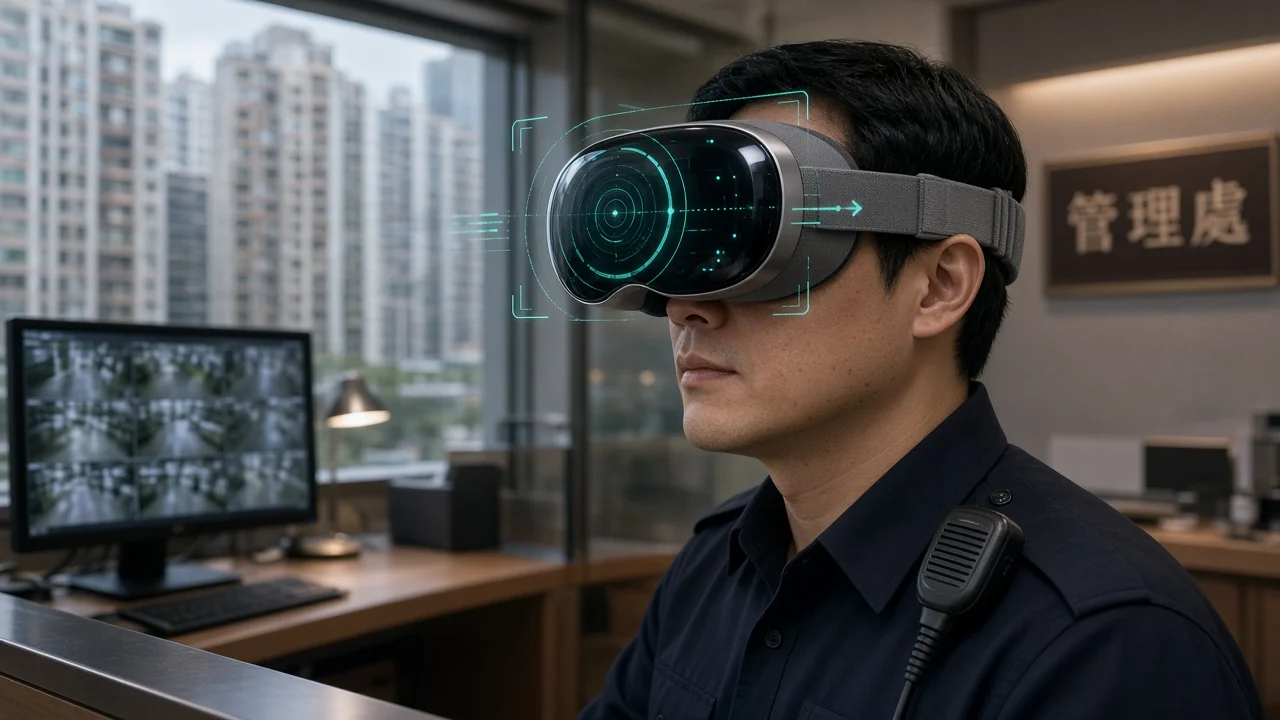
Three Training Modes: PMTP features Training Mode (with guided prompts), Assessment Mode (no prompts, testing actual competency) and Accident Preview Mode (patent pending) — allowing staff to experience the consequences of accidents in a safe environment, deepening risk awareness.
The platform supports haptic feedback and can integrate with existing Human Resources Systems (HRS) or Learning Management Systems (LMS), writing training records directly into the company’s employee database.
ROI Comparison: VR Training vs. Traditional Training
VTM PMTP platform data
VTM PMTP platform data
VTM PMTP platform data
| Comparison Dimension | Traditional Training (Classroom / Off-site) | VTM PMTP VR Training |
|---|---|---|
| Training Costs | Venue hire, external instructors, transport, lost productivity | Marginal costs significantly reduced after purchase: training cost savings of up to 40% |
| Skill Acquisition Speed | Dependent on instructor quality and classroom interaction | Skill training speed increased by 70% (staff can repeat practice immediately) |
| Incident Rate | Frontline staff rely on classroom memory; high forgetting rate | Incident rate reduced by 65% (immersive scenarios reinforce operational memory) |
| Frontline Staff Retention | Repetitive training is monotonous; long adjustment period for new staff | Stronger VR experience, faster onboarding, helps shorten adaptation period |
| Training Records | Paper sign-in sheets; lack performance data | Auto-generated structured reports, available for PMSA or landlord review |
| Location Flexibility | Staff must leave their post for off-site training | Can be conducted at office or management office; no need to leave post |
| Scale Replication | Sessions limited by instructor availability and venue capacity | Add headsets to scale simultaneously; unified standards across all properties |
| Government Accreditation | Depends on the qualifications of the outsourced provider | Smart Lab S-0644 government-accredited solution |
Source: the 40% training cost reduction, 70% skill training speed increase, and 65% incident rate reduction figures all come from data published on the VTM PMTP platform page (vtmdigital.com/en/pmtp/).
AAHK Third Runway Pilot: Over 80% Operational Accuracy
The Hong Kong International Airport Third Runway expansion project (AAHK Third Runway) is one of the flagship pilot deployments of VTM PMTP.
In the project’s on-site pilot, contracted workers underwent PMTP VR training with the following result: after just two training sessions, operational accuracy exceeded 80%.
The context behind this figure is worth noting:
- ‘Two sessions’ means frontline staff can rapidly reach an executable standard without prolonged time away from their posts
- ‘On-site pilot’ was measured in a real work-site environment, not laboratory conditions
- ‘Operational accuracy’ reflects staff’s ability to follow procedures in simulated scenarios, not merely a comprehension test
For property management companies, the key takeaway from this case is that VR training does not merely achieve a ‘been-trained’ status — it can reach quantifiable operational standards within a limited time frame. This is precisely the type of evidence most needed in property management contract performance assessments and landlord reviews.
Nan Fung Group Case Study: Real Data from Large-Scale Deployment
Nan Fung Property Management is one of PMTP’s flagship clients in Hong Kong’s private market:
- Client scale: 80 properties under management, 1,800 employees
- VR course scale: over 60 VR sessions conducted, totalling 400+ participant-attendances (not unique headcount)
- Primary application areas: Cleaning & Engineering
- Training scenarios: working-at-heights falls (gondola, scaffolding), fire extinguisher use and fire response, property inspection, safety harness compliance
- Course management: monthly VR sessions facilitated by Safety Officers and Senior Security Officers
The Nan Fung case illustrates the most practical challenge for mid-to-large property management companies: how to maintain consistent training standards across 80 properties distributed across different districts, while managing the knowledge transfer pressures caused by frontline staff turnover? Traditional training methods require arranging different instructors for each management office, making quality consistency difficult to achieve. PMTP’s VR modules ensure that every employee — regardless of which estate they work at — receives identical training content and assessment standards. This standardisation is itself the most powerful way to demonstrate management quality to Owners’ Corporations and major landlords.
Further Reading
- Facility Management VR Training: Tenant Communication, Emergency Response and Green Operations in Hong Kong — How VR training covers the full spectrum of facility management scenarios, from resident communication to emergency drills
- How Hong Kong’s Property Management VR Training Is Solving Europe’s Facility Management Crisis — How Hong Kong’s VR training model is addressing facility management challenges internationally
- TVP Closed (31 Dec 2024): Archived VR/XR Training Guide | VTM Digital — Archived reference guide for funding VR/XR training in Hong Kong
Frequently Asked Questions (FAQ)
If you are considering evaluating the PMTP solution, contact VTM to arrange a demonstration. The VTM team will provide specific recommendations based on your property portfolio size and staff training needs.
Book a DemoFurther Reading
- How Mixed Reality (MR) Training Helps Hong Kong Companies Achieve OSH Compliance: Regulatory Mapping × Risk Management ROI × Implementation Roadmap
- XR Training for Vocational and Professional Education in Hong Kong: How VPET Institutions Are Adopting VR
- VR Training for Vocational Education and Technical Institutes in Hong Kong: Bridging the Skills Gap with XR
- AR and MR Training in Hong Kong: The Complete Enterprise Guide to Augmented and Mixed Reality Safety Training


