
What is VR Safety Training? A Definition
VR safety training uses head-mounted display technology to place workers inside a photorealistic simulated hazard environment, where they practise emergency responses without physical risk. Unlike video-based training, workers physically move and react to scenarios — making decisions that are recorded and scored automatically. Training records are generated in formats accepted by the Labour Department Occupational Safety branch and Construction Industry Council (CIC).
VR vs Traditional Safety Training: A Direct Comparison
| Factor | VR Training | Traditional Classroom |
|---|---|---|
| Hazard realism | Full immersive simulation | Photos/video only |
| Knowledge retention | Up to 75% (PwC 2020) | 10–20% classroom average |
| Repeat session cost | Near-zero marginal cost | Full trainer + venue each time |
| Compliance records | Auto-generated, audit-ready | Manual — prone to gaps |
How the Training Works: Core Mechanism and Workflow
The process follows three stages: (1) Scenario loading — the system presents a hazard situation based on the site’s risk profile and the worker’s assigned module; (2) Active response — the worker identifies, reacts to and resolves the hazard in real time, with the system measuring response accuracy and speed; (3) Automatic debrief — a performance record is generated and stored in the training management dashboard. This workflow is consistent regardless of trainer availability, ensuring standardised outcomes across large workforces.
Facility managers in Hong Kong face a uniquely complex training challenge. Their teams — responsible for maintaining the safety, functionality, and habitability of buildings across millions of square metres of residential, commercial, and mixed-use space — must be simultaneously technically competent, customer-facing, and emergency-ready. Training these multi-skilled teams efficiently, at scale, and without disrupting building operations, is one of the most persistent operational challenges in Hong Kong’s property management sector.
Virtual reality training is increasingly providing the answer. This guide covers how VR is transforming facility management capability development across three critical dimensions: tenant communication and conflict de-escalation, emergency response and crisis management, and sustainable operations and green facility management.
Tenant Communication VR Training: The Skills Gap That Drives Complaints
Tenant satisfaction surveys consistently identify communication quality — not technical response time — as the primary driver of property management satisfaction scores. A maintenance issue resolved in 4 hours with poor communication generates more complaints than the same issue resolved in 8 hours with proactive, empathetic updates.
Yet tenant communication skills are among the hardest to train through traditional methods. Role-play exercises in classroom settings feel artificial. Watching videos of best-practice interactions doesn’t translate into behaviour change under pressure. And sending untrained staff to handle difficult tenant interactions directly generates complaints that damage client relationships before any learning has occurred.
VR changes the training dynamic fundamentally. VTM’s Property Management Training Platform (PMTP) includes a suite of tenant communication simulation scenarios developed specifically for Hong Kong’s property management context:
Practice the full arc of a challenging complaint conversation — acknowledgement, investigation, resolution, and follow-up — with AI-driven tenant responses that adapt to trainee behaviour in real time.
Train staff to handle service interactions with English-speaking, Putonghua-speaking, and other non-Cantonese tenants — building language confidence and cultural sensitivity without real consequence.
Practice messaging tenants through property management apps, email, and notice systems with appropriate tone, timing, and content for different communication scenarios.
Navigate the delicate role of mediating noise complaints, parking disputes, and common area conflicts — one of the highest-stakes tenant communication scenarios in residential management.
Emergency Response VR Training for Facility Management Teams
Emergency preparedness is non-negotiable in facility management — but emergency training is expensive, disruptive, and infrequent. Physical fire drills, lift rescue rehearsals, and flooding response exercises require coordinating large numbers of staff, often involving building shut-downs or external contractor mobilisation. As a result, many property management teams conduct formal emergency training once a year — which is far less than what’s needed to build reliable response reflexes.
VR addresses this frequency constraint directly. Emergency response scenarios can be run during a 20-minute slot before a shift starts, requiring no physical space setup, no external contractors, and no building disruption. Staff can repeat scenarios until performance standards are met, rather than waiting for the next annual exercise.
VTM PMTP’s emergency response modules for facility management cover:
Lift Entrapment Response
The complete response protocol from first notification to full resolution, including passenger communication, coordination with lift maintenance contractors, and post-incident reporting. Scenario variants include single occupant, multiple occupants with a medical emergency, and occupants with mobility limitations.
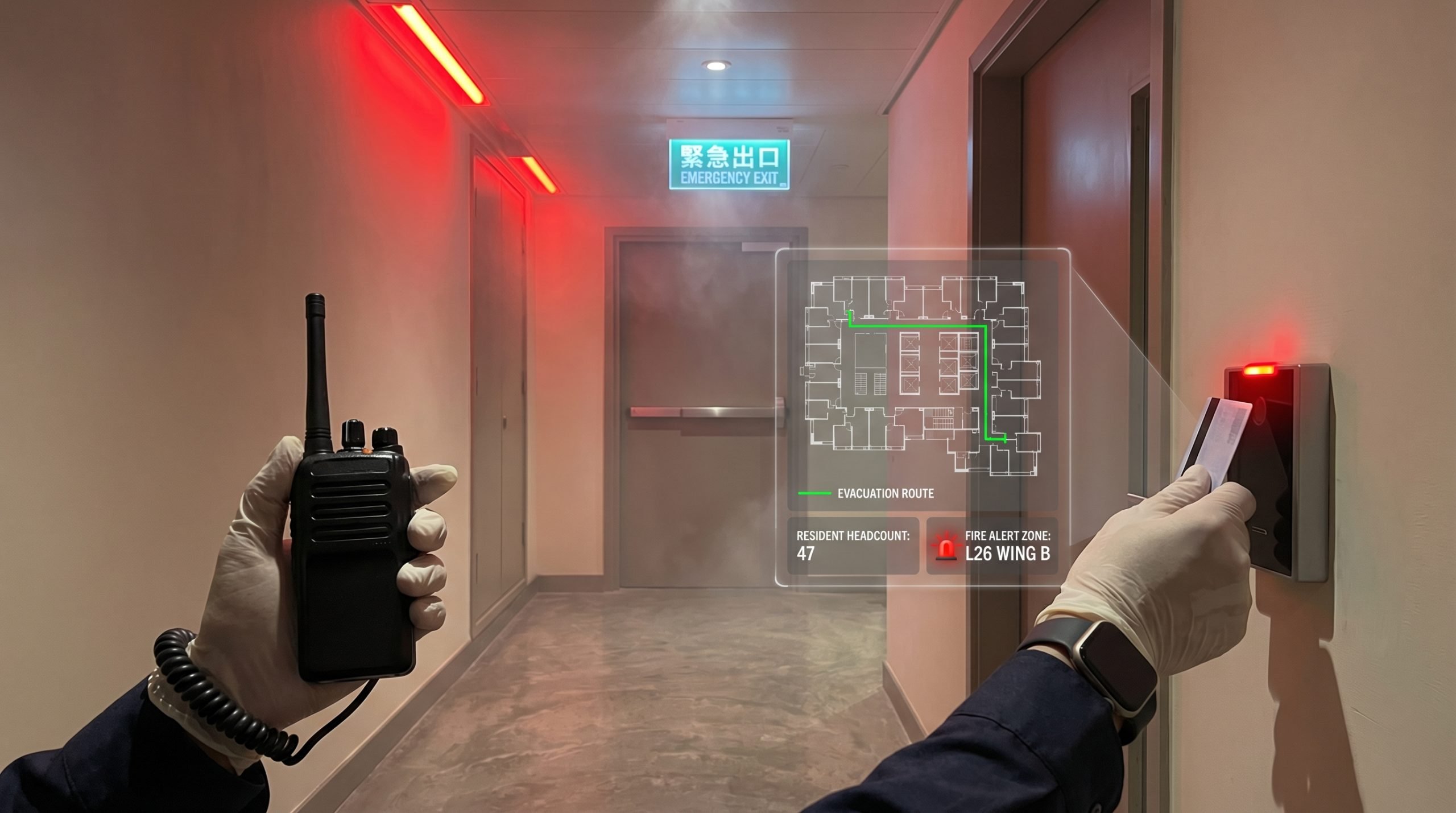
Fire Alarm and Evacuation Coordination
Managing building-wide evacuation across multiple zones, coordinating with fire services, handling non-compliant occupants, and assisting mobility-impaired persons to refuge areas. Scenarios simulate low-visibility conditions and high-noise environments that compromise normal communication protocols.
Water Damage and Infrastructure Failure
First-response isolation procedures for burst pipes and flooding incidents, including identifying isolation valves, communicating with affected tenants, and managing secondary risk mitigation while awaiting specialist contractor arrival.
Medical Emergency Response
Responding to a tenant medical emergency — contacting emergency services, providing first aid support, managing crowd control, and coordinating with paramedics on arrival. Includes AED deployment training integrated with the virtual scenario.
Green Facility Management Training: Building the Next-Generation Workforce
Hong Kong’s BEAM Plus certification framework, the government’s Net Zero 2050 commitment, and increasing tenant demand for ESG-aligned buildings are fundamentally changing the skill requirements for facility management professionals. The next generation of facility managers needs to understand energy management systems, water conservation protocols, waste reduction programmes, and green building certification maintenance.
Traditional training for green facility management has relied on classroom courses and certification programmes that are costly, time-consuming, and often disconnected from the actual building systems teams will manage. VR training provides an experiential alternative that is particularly valuable for:
Building Energy Management System (BEMS) Operation
VR simulations of building energy monitoring dashboards allow facility engineers to develop intuitive familiarity with BEMS interfaces before operating live systems. Trainees can explore the impact of HVAC scheduling adjustments, lighting control modifications, and chiller plant optimisation in a simulated environment where mistakes have no real-world consequences.
Sustainability Audit Procedure Training
Walking through a virtual building to conduct energy waste identification, water system inspection for leakage, and waste sorting compliance checks — building the observational habits needed for effective sustainability operations.
ESG Reporting and Tenant Communication
Explaining green building features, energy performance data, and sustainability initiatives to tenants — a growing expectation in Grade-A commercial properties — requires both technical knowledge and clear communication skills. VR simulation scenarios combine both.
Implementation Model: How to Deploy VR Training Without Disrupting Operations
Facility management operations run 24/7. Training deployment must work around operational realities, not vice versa. VTM recommends the following implementation model for property management companies:
- Rotation training station: Establish a small dedicated VR training space in the property management office, available for pre-shift and post-shift training sessions without requiring staff to leave the building
- Micro-session design: Structure training in 15–20 minute modules that fit naturally into handover periods and staff breaks
- Multi-site equipment rotation: For large property management companies with multiple estates, VTM provides equipment rotation schedules that deliver regular training access across all sites without requiring each site to maintain its own hardware
- Supervisor accountability integration: VTM’s training dashboard gives estate managers real-time visibility of team training completion and performance, integrating VR training compliance into existing supervision workflows
How PMTP Integrates with Broader Property Management Operations
VTM’s Property Management Training Platform is designed to complement, not replace, existing property management systems. Key integration touchpoints include:
- Staff competency records: Training completion and performance data exports for integration with HR and payroll systems
- Compliance audit support: Training records formatted for BEAM Plus, Fire Services Department, and Labour Department audit requirements
- Onboarding workflow integration: New staff complete core PMTP modules as part of induction, before accessing live building systems or managing tenant interactions independently
- Annual refresher scheduling: Automated reminders for mandatory refresher training on emergency response and compliance modules
Upgrade Your Facility Management Team’s Capabilities
VTM Digital offers a free PMTP demonstration for property management companies and facility management teams. Experience the tenant communication, emergency response, and sustainability training modules firsthand — and explore how PMTP would fit into your operational training framework.


