
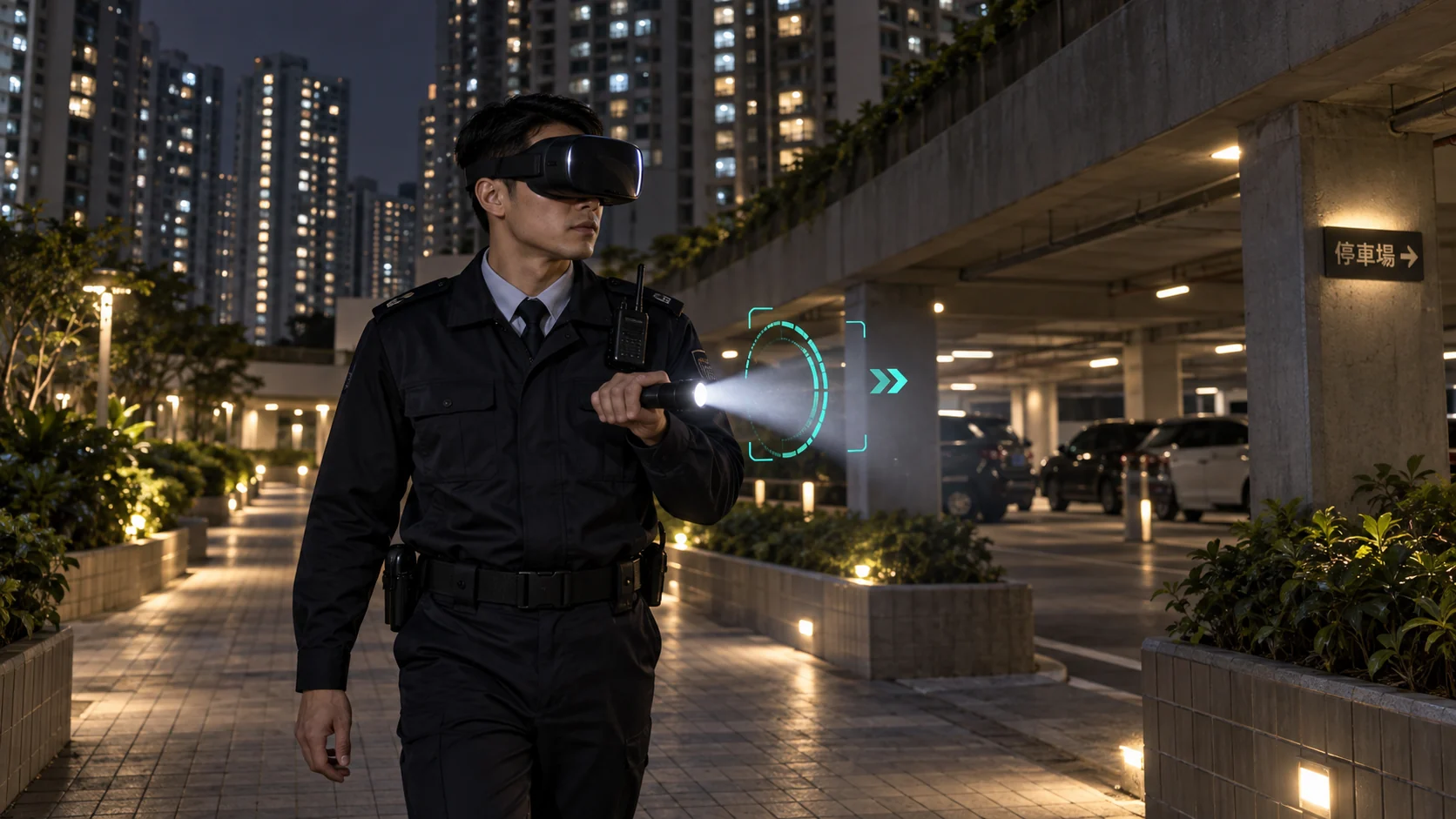
Top 5 Occupational Safety Risks for Hong Kong Property Management Frontline Staff: How PMTP VR Simulates Each One (2026 OHS Compliance Guide)
Hong Kong property management frontline staff face five major occupational safety risks: working at height, chemical exposure, slips and falls, mechanical equipment operation, and confrontation or violence incidents. VTM Digital’s PMTP uses VR simulation to let employees safely practise emergency response procedures for each scenario in a virtual environment — meeting PMSA licensed training requirements and Smart Lab S0644 accreditation standards.
The Five Major Occupational Safety Risks for Hong Kong Property Management Frontline Staff
Inside any building, a cleaner stands on a gondola washing exterior glass; an M&E engineer enters a plant room for a routine check; a reception security guard faces an agitated tenant alone at midnight. These are not edge cases — they are scenarios frontline property management staff may encounter on any given shift in Hong Kong.
Occupational Safety and Health Council (OSHC) data for the building services industry consistently shows that frontline property management injuries are concentrated in working at height, slips and falls, and chemical exposure categories. The root cause is rarely that employees don’t know the procedures — it’s that when a real incident unfolds under pressure, they lack the practised memory to recall and execute. Classroom training helps people remember procedures; VR training lets them rehearse under pressure until it becomes muscle memory.
5 OHS Risks × PMTP Training Modules: Comparison Table
Each of the five risk types differs in role exposure, relevant regulations, gaps in traditional training, and the VR simulation approach needed to address it. The table below maps the full OHS risk landscape for HK property management frontline work — procurement managers can use it as a reference against their own workforce role structure.
| Risk Type | Typical Scenario | Relevant Regulations / Guidelines | Gap in Traditional Training | PMTP VR Simulation Direction | Compliance Alignment |
|---|---|---|---|---|---|
| Working at Height — Cleaning & Maintenance | Exterior glass cleaning, gondola operations, rooftop edge work | Labour Department Working at Heights Safety Regulations; OSHC Working at Heights Guidelines | Real high-elevation practice is hazardous; physical drills carry significant risk | Virtual gondola operation scenarios — practise harness fastening procedures and emergency response to gondola malfunction | PMSA CPD training hours; Smart Lab S0644; PA24-072 |
| Chemical & Cleaning Agent Exposure | Plant room chemical cleaning, disinfectant spraying, handling strong acid/alkali cleaners | Labour Department Chemical Safety Regulations; OSHC Chemical Hazards Guidelines | Live chemical drills raise safety concerns; learner exposure is heavily restricted | Virtual plant room chemical spill scenarios — practise PPE donning, spill containment and first-aid reporting procedures | PMSA licensed training requirements |
| Slips, Trips & Falls | Common area floor cleaning without wet-floor signage, resulting in slip accidents | Labour Department Workplace Safety Guidelines; OSHC Fall Prevention Guidelines | Classroom settings cannot replicate the real hazard level of wet floors | Virtual corridor cleaning scenarios — practise wet-floor sign placement timing and slip incident reporting procedures | Smart Lab S0644 |
| Mechanical & Electrical Equipment Operation | Plant room routine inspection and maintenance, Lockout/Tagout procedure execution | Labour Department Machinery Safety Regulations; OSHC Machinery Hazards Guidelines | Entering a live plant room for drills is dangerous; manufacturing equipment fault scenarios for practice is impractical | Virtual plant room / equipment room scenarios — practise Lockout/Tagout, abnormal noise investigation and escalation procedures | PMSA licensed training; PA24-072 |
| Confrontation & Violence Incidents | Reception disputes, late-night security assistance situations, mental health crisis management | Labour Department Prevention of Workplace Violence Guidelines; OSHC Workplace Violence Guidelines | Role-play scenarios struggle to replicate real pressure; learners tend to disengage from the exercise | Virtual reception confrontation scenarios with adjustable conflict escalation levels — practise de-escalation techniques and emergency assistance procedures | PMSA CPD training hours |
PMTP’s Accreditations: The Three Frameworks Procurement Managers Need to Know
For property management company procurement managers, the primary consideration when selecting a VR training solution is compliance. PMTP holds both government technology review accreditation and industry training accreditation — covering both dimensions:
Smart Lab S0644 Accreditation: Smart Lab is Hong Kong’s government technology review framework. S0644 accreditation means PMTP has passed an independent technical review as a VR tool for occupational safety and health training. For property management companies, this accreditation is a commonly referenced benchmark in government procurement and corporate audits, and can simplify internal procurement approval processes.
PA24-072 Accreditation: PA24-072 is a government accreditation framework for occupational safety and health training. Holding this accreditation means the training content meets government-prescribed standards — it can serve as compliance evidence in procurement assessments and tender documents, and is most valuable for property management companies with government or public housing management contracts.
PMSA Licensed Training Requirements: The Property Management Services Authority (PMSA) prescribes Continuing Professional Development (CPD) training requirements for licensed property management practitioners. PMTP training records can be managed through an LMS system, making it straightforward for managers to compile training-hour records in PMSA-compatible formats — eliminating the administrative burden of manual record consolidation.
For details and procurement enquiries, visit the VTM PMTP service page.
Nan Fung: A Real-World Case Study of Large-Scale Deployment
Theoretical feasibility is one thing; rolling out across multiple properties simultaneously across Hong Kong is another. Nan Fung Group’s PMTP deployment offers a rare industry-scale reference point:
included in the training programme
covering all frontline staff
deployed uniformly across properties
automatically archived in LMS
These figures demonstrate operational scalability — that property management companies can execute unified cross-property VR training deployment, both administratively and technically. Throughout the deployment, VTM Digital managed training content, LMS record-keeping and cross-property coordination support, enabling Nan Fung’s training managers to monitor completion rates across all properties from a centralised view.
(Data source: VTM Digital project records)
Procurement Decision Guide: How to Prioritise by Employee Risk Distribution
Occupational safety and health risks are not evenly distributed across property management workforces. Frontline cleaning and maintenance staff face higher exposure to working-at-height and chemical risks, while reception and security staff are more frequently exposed to confrontation and violence risks. Understanding this distribution is what makes limited budgets count — directing spend to the highest-risk roles first.
Which Employee Categories Face the Highest Risk and Should Be Prioritised for PMTP Modules?
| Employee Category | Primary Risks | Recommended Priority Modules |
|---|---|---|
| Exterior Cleaning / Working at Height Maintenance Staff | Fall from height, gondola malfunction | Working at Height module, emergency procedure drills |
| M&E Maintenance Staff | Mechanical/electrical equipment accidents, chemical exposure | Plant room safety, Lockout/Tagout, chemical handling |
| Cleaning Staff | Slips and falls, chemical exposure | Floor cleaning signage procedures, chemical safety |
| Reception Security / Customer Service Staff | Confrontation, workplace violence | De-escalation techniques, emergency assistance procedures |
| Management / Supervisors | Comprehensive compliance awareness | PMSA requirements, incident reporting frameworks |
Procurement managers are advised to conduct a workforce risk assessment first — identify the proportion of high-risk roles, then determine the priority deployment sequence for PMTP modules. VTM can provide an initial consultation to help design a training plan scaled to your organisation’s needs.
Find out how PMTP fits your workforce occupational safety training plan
View PMTP Solution DetailsRegulatory References
Occupational Safety and Health Council (OSHC) (oshc.org.hk): OSHC publishes annual occupational safety data and guidelines for the building services industry. Property management companies can use OSHC’s risk assessment frameworks to identify the primary hazard types relevant to their workforce.
Labour Department (labour.gov.hk): The Labour Department has prescribed guidelines and statutory requirements covering working at height, chemical safety, and prevention of workplace violence. Employers are obligated to assess risks and provide appropriate training.
Property Management Services Authority (PMSA) (pmsa.org.hk): PMSA prescribes training and CPD requirements for licensed property management practitioners and property management companies. When procuring VR training solutions, confirm that records can be generated in PMSA-compatible formats.
Frequently Asked Questions
Further Reading
- VTM PMTP Property Management VR Training Platform — Full Solution Overview
- Property Management Group VR Training Standardisation | VTM PMTP
- Complete Guide to VR Training for Hong Kong Property Management Companies: PMSA Licensing Requirements, Smart Lab S0644 Accreditation, and PMTP Platform ROI Analysis (2026)
- VR Training Analytics and LMS Integration: How to Measure Safety Training ROI in 2026
- VR vs Traditional Safety Training ROI: The Hong Kong Enterprise Decision Guide (2026)
- The Proven Benefits of Immersive VR Safety Training: ROI, Retention & Real-World Results
- XR Workplace Training: The Proven Benefits of Immersive Safety Training for Frontline Workers
Sources:
- Occupational Safety and Health Council (OSHC) (oshc.org.hk)
- Labour Department (labour.gov.hk)
- Property Management Services Authority (PMSA) (pmsa.org.hk)
- VTM Digital project records (Nan Fung PMTP deployment data)


