
The Vocational Training Council’s 2024 Industry Training Advisory Committee report flagged a persistent problem: vocational graduates who understand safety procedures but have never practised them in realistic conditions. The first time many students encounter a live site hazard is on their first day of work placement. XR changes that sequence entirely.
This guide brings together everything Hong Kong school administrators, curriculum directors, and education technology coordinators need to know about implementing VR and XR in primary schools, secondary schools, and vocational education institutions — from available funding through the Education Bureau’s Smart School initiatives to the technical requirements for a successful classroom deployment.
Why XR in Education? The Case for Hong Kong Schools
The traditional classroom model — a teacher at the front, students in rows — was designed for a different era. Today’s students are digital natives who learn through interaction, exploration, and experience. XR technology meets learners where they are, transforming abstract concepts into tangible, explorable environments.
According to Hong Kong’s Labour Department Occupational Safety and Health Branch, employers in the construction industry are required to ensure all workers complete relevant safety training before deployment. The Construction Industry Council (CIC) continuously updates approved training standards, which organisations can reference when designing their training programmes.
Consider what becomes possible with VR in schools:
- History and Geography: Students walk through ancient Rome, explore the Amazon rainforest ecosystem, or witness geological formations forming over millennia — all in a 45-minute lesson
- Science and STEM: Dissect a frog virtually, explore the human circulatory system from the inside, or simulate chemical reactions in a safe environment
- Vocational and Safety Training: Secondary students pursuing construction, engineering, or facility management tracks practice real-world skills before setting foot on an actual site
- Language and Cultural Immersion: Cantonese, Mandarin, and English language learners practise in immersive cultural contexts, accelerating vocabulary acquisition and confidence
VTM XR Academy: Hong Kong’s Dedicated XR Education Platform
VTM’s XR Academy is specifically designed for the Hong Kong education sector. Unlike enterprise VR training platforms repurposed for schools, XR Academy was built from the ground up to align with Hong Kong’s curriculum frameworks, classroom logistics, and the practical realities of school IT infrastructure.
The XR Academy platform provides schools with:
Pre-built VR experiences mapped to Hong Kong’s curriculum for Science, Geography, History, and vocational subjects. New modules released each academic term.
Comprehensive onboarding for teachers with no prior VR experience. VTM’s education team provides ongoing pedagogical support to help teachers integrate XR meaningfully into lesson plans.
Real-time tracking of student engagement, time-on-task, and learning outcomes for each XR module — giving teachers actionable data to inform lesson planning.
VTM handles device setup, network configuration, and ongoing technical maintenance, removing IT burden from school staff.
Primary School VR Learning: Making the Abstract Tangible
For primary school students (Primary 1–6), VR’s greatest strength lies in making abstract concepts concrete. A Primary 4 student struggling to understand water cycle processes can experience the full journey of a water droplet — evaporation, condensation, and precipitation — in a 10-minute VR experience that no textbook diagram can replicate.
VTM XR Academy’s primary school modules are designed for short, focused learning bursts (10–20 minutes) that fit naturally into existing lesson structures. Content is available in both Cantonese and English, supporting Hong Kong’s bilingual education environment. Key primary school subject areas covered include:
- General Studies: Life sciences, environmental education, Hong Kong history and culture
- Science: Physical phenomena, simple machines, weather systems
- Mathematics: 3D shape exploration, spatial reasoning, data visualisation
- Arts and Culture: Virtual museum visits, art history immersion
Secondary School XR: Bridging Academic and Vocational Pathways
Secondary students benefit from XR across two distinct dimensions: academic enrichment and vocational preparation. The Secondary 4–6 cohort, in particular, gains significant value from VR-based vocational exposure — helping students make more informed subject and career choices before committing to post-secondary pathways.
VTM XR Academy’s secondary school offering aligns with the four key learning areas of Hong Kong’s New Senior Secondary curriculum:
- STEM integration: Physics simulations, chemistry lab experiences, biology dissections
- Applied Learning (ApL): VR modules for Construction Safety, Engineering, and Hospitality — directly supporting Applied Learning subject requirements
- Career and Life Planning: Immersive workplace simulations across industries — construction, healthcare, aviation, hospitality — to inform career exploration
- Other Learning Experiences (OLE): Community service simulations, environmental conservation experiences
Vocational Education and Technical Training: VR as a Safety Foundation
For Hong Kong’s vocational education institutions — including Vocational Training Council (VTC) programmes, Industry Training Advisory Committees, and post-secondary technical institutes — VR training serves a particularly critical safety function. Students entering construction, engineering, electrical, and facility management trades need foundational safety exposure before entering actual worksites.
VTM’s Construction Training Platform (CTP), which is also deployed in VTC-type settings, provides students with immersive exposure to:
- Working at height safety procedures
- Confined space entry protocols
- Crane and heavy machinery operation awareness
- Emergency response and first aid scenarios
This VR safety foundation means students arrive at actual training worksites with genuine situational awareness — reducing the risk of incidents during practical training and improving the effectiveness of hands-on supervision.
Funding XR in Hong Kong Schools: What’s Available?
Cost is the first concern most school administrators raise. The good news: multiple funding streams exist specifically to support technology adoption in Hong Kong schools.
Education Bureau Smart School Initiative
The Education Bureau’s ongoing initiatives for e-learning and STEM development provide recurrent grants to schools for technology infrastructure and software. VR hardware and software licences typically qualify under the IT in Education and STEM education funding categories.
Innovation and Technology Fund (ITF)
Schools and education NGOs may qualify for Innovation and Technology Fund grants for XR technology adoption. VTM can assist schools in preparing grant applications demonstrating the pedagogical value of XR implementation.
QEF (Quality Education Fund)
The Quality Education Fund actively funds innovative education projects, including technology-enhanced learning initiatives. Previous QEF-funded projects have included immersive learning technology deployments in Hong Kong schools.
School-Based Management Grants
Schools with discretionary use of School-Based Management funds can allocate portions of these grants toward XR technology pilots, particularly where the technology directly supports curriculum objectives.
Implementation Considerations for Hong Kong Schools
Classroom Management with VR Headsets
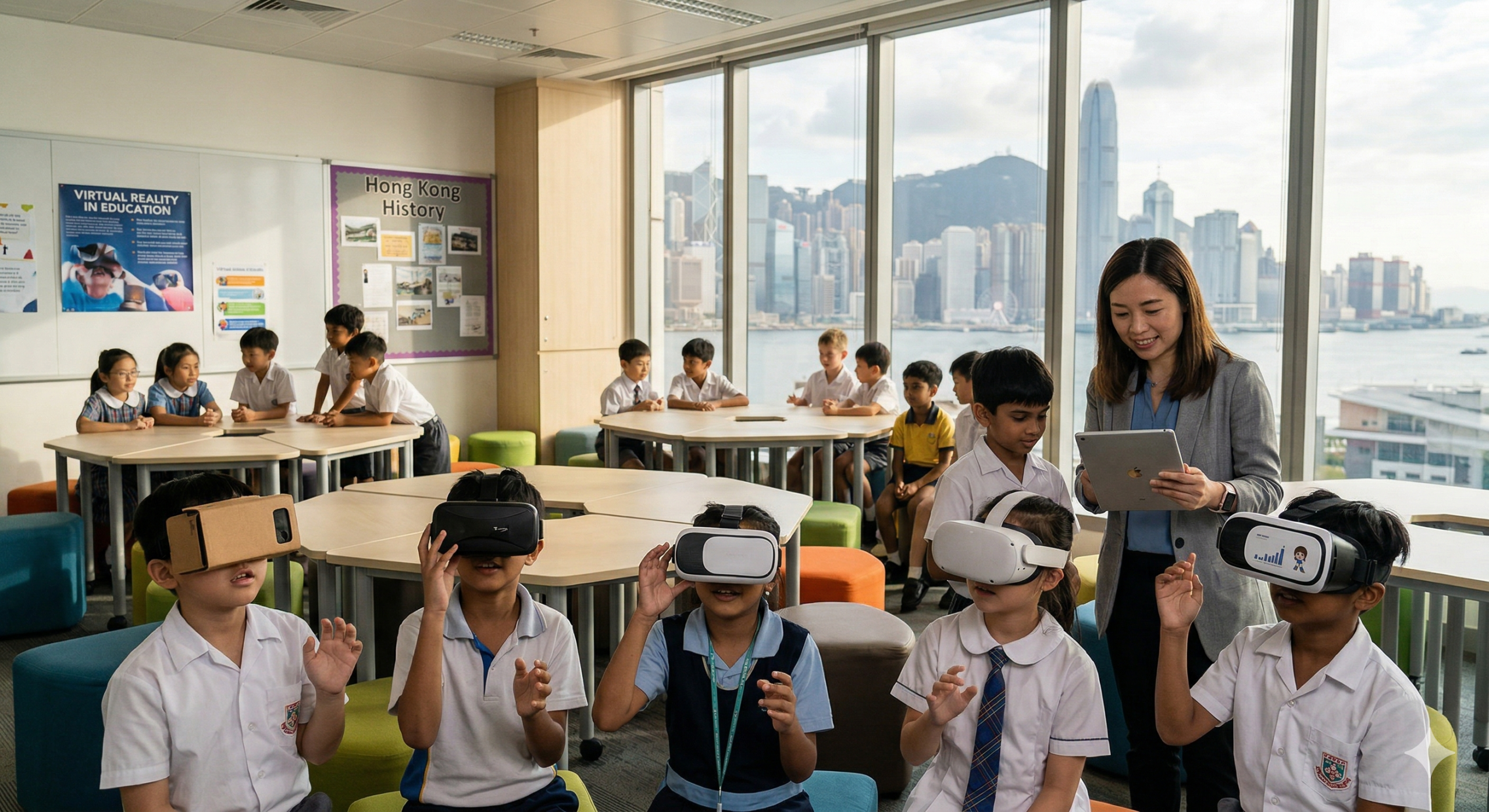
Managing 30 students in VR headsets simultaneously requires careful classroom design. VTM recommends a “rotation model” — dividing the class into groups with different tasks, cycling one group through the VR experience at a time. This approach reduces headset requirements (as few as 6–8 devices can serve a class of 30) and maintains teacher supervision quality.
Device Hygiene and Maintenance
Schools should establish clear protocols for headset cleaning between uses, particularly in primary schools. VTM provides hygiene guidance and recommends disposable face cushion covers as a cost-effective solution.
Parental Communication and Consent
For students under 13, schools should obtain parental consent for VR use and communicate the educational purpose clearly. VTM provides template parent communication letters and FAQs in both English and Chinese.
Staff Confidence and Professional Development
Teacher confidence with VR technology is the single biggest factor in successful school deployment. VTM’s teacher training programme — delivered through workshops and an online support portal — ensures all participating teachers feel genuinely prepared before going live with students.
Bring XR Learning to Your School
VTM Digital offers school demonstration sessions where your teachers and students can experience XR Academy modules firsthand — no technical setup required on your part. Book a free school visit and discover which curriculum areas would benefit most from VR integration.


