
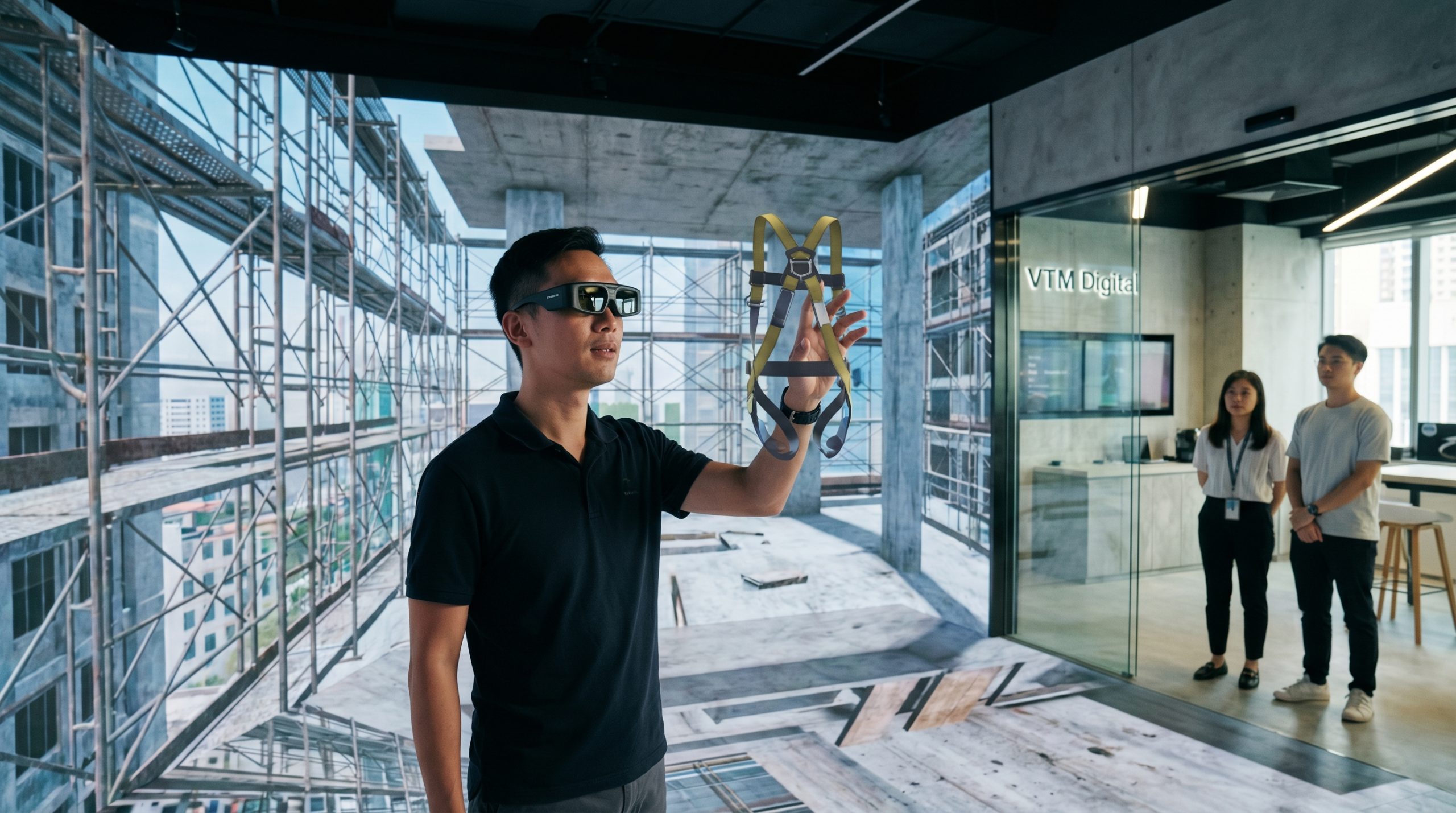
This article is based on VTM Digital’s official YouTube collaboration with Sino Inno Lab: “信和創意研發室 Sino Inno Lab × VTM Digital | Immersive VR Cave Safety Training”. Content draws on the video and additional industry research to provide deeper analysis.
▶ Watch the original video
Every safety officer managing a Hong Kong construction site knows the uncomfortable truth: you can run a hundred hours of briefings, show every fall-from-height video in the library, and workers will nod, sign the attendance sheet, and walk onto the scaffolding the next morning with the same behavioural habits they had before. Rules learned in a classroom are not the same as instincts built through experience.
Sino Group understood this. So they invested in a different kind of solution — and chose to build it at Sino Inno Lab, their open innovation and technology demonstration centre in Hong Kong, in partnership with VTM Digital. Together, they deployed what is among the first CAVE-based immersive VR safety training systems purpose-built for Hong Kong’s construction sector.
What Traditional Safety Training Cannot Fix: The Cognition-Behaviour Gap
The head of Sino Inno Lab was direct about the limitation they were trying to solve:
This observation points to one of the most well-documented challenges in occupational safety research: cognitive learning and procedural memory are not the same thing. Workers can pass written assessments on fall arrest procedures with perfect scores. Under real site conditions — noise, heat, simultaneous task demands, time pressure — the same workers may not execute those procedures correctly, because the behaviour was never encoded at the physical level.
Procedural memory — the automatic, instinctive execution of a skill under stress — develops through repeated, high-fidelity physical rehearsal. Not through watching videos. Not through reading. Through doing, under conditions that generate real physiological responses.
The question is how to create those conditions without putting workers in actual danger.
What Is a VR Cave, and Why Choose It for Safety Training?
Most people associate VR training with standalone headsets — Meta Quest, Apple Vision Pro, or Samsung Moohan units worn individually. VTM Digital’s CTP platform uses headset-based VR extensively, and has trained over 80,000 workers across Hong Kong in this format.
The Sino Inno Lab collaboration uses a different technology: Cave Automatic Virtual Environment (CAVE). CAVE was originally developed in 1992 by Carolina Cruz-Neira, Daniel Sandin, and Thomas DeFanti at the Electronic Visualization Laboratory at the University of Illinois — named intentionally as a reference to Plato’s allegory of the cave, where shadows on a wall create the impression of reality. In a VR Cave, the walls of a room are the display surfaces. Users wear lightweight 3D glasses rather than headsets. Tracking sensors adjust projections in real time. Multiple people can share the same virtual environment while remaining physically visible to each other.
| Dimension | Headset VR | VR Cave |
|---|---|---|
| Immersion depth | High — full field of view within headset | Extreme — room-scale, no headset boundary |
| Motion sickness risk | Moderate — screen latency can cause discomfort | Low — natural body movement with real spatial cues |
| Multi-person training | Independent parallel sessions | Multiple people in same virtual space simultaneously |
| Height and spatial fear response | Strong in headset context | Stronger — room-scale drop simulation activates genuine stress response |
| Deployment model | Portable, large-scale rollout | Fixed facility — training centre or innovation hub |
| Cost per session (at scale) | Lower — headsets are deployable anywhere | Higher fixed cost, near-zero marginal cost per session |
The headset approach remains VTM’s primary deployment format for site-scale training — portable, scalable, CITF-eligible, and capable of handling the 80+ module scenarios required across different trade disciplines. VR Cave’s role is different: for the highest-stakes scenarios, where the depth of physiological response matters most, and where multiple trainees need to coordinate in a shared simulated environment.
Internationally, CAVE-based simulation has been used for industrial safety and high-risk procedural training in aviation (Boeing has applied similar immersive environment technology for aircraft assembly and maintenance training), defence (the US Army Research Laboratory has used CAVE environments for cognitive load research in complex operations since the early 2000s), and nuclear energy plant emergency response training in France and Japan.
Sino Inno Lab × VTM Digital: Three Scenarios Built for Hong Kong Construction
Sino Inno Lab is Sino Group’s open technology and innovation platform — a demonstration and validation centre where PropTech and ConTech solutions are tested, verified, and showcased to industry partners. Its mandate is to advance construction technology adoption across the Hong Kong real estate sector.
The choice of VTM Digital as the technical partner reflects a specific requirement: VTM’s CTP platform is not a generic VR content library. Every module is designed to align with Hong Kong Labour Department occupational safety standards and Construction Industry Council (CIC) training protocols. Content is built for Hong Kong site conditions — not adapted from US or UK templates.
VTM’s technical lead: “We worked closely with the Sino team to develop three VR Cave modules targeting Hong Kong construction’s highest-frequency accident scenarios. The development team was meticulous about every detail — restoring each hazard scenario accurately and ensuring training content reflects real site conditions while effectively raising safety awareness.”
The three modules:
- High-rise scaffolding safety — Workers stand on a virtual platform 30 metres above a construction site. The scenario requires correct safety harness attachment, then simulates a sudden cable failure — floor panels drop, the spatial fall response activates. Behaviour is encoded, not just described.
- Heavy crane coordination and spatial safety — Simulation of a crane lift operation, requiring workers to judge exclusion zones as a tower crane arm sweeps overhead. Multi-person coordination protocols are practised in real-time shared virtual space.
- Confined space emergency response — Workers navigate a simulated confined workspace and execute a full emergency evacuation procedure, including correct communication sequence and physical egress under simulated atmosphere degradation.
What Changes After Training: From Compliance to Instinct
Sino Inno Lab’s observation of workers after their first VR Cave session: the universal initial reaction is “I actually thought I was going to fall.” This response is precisely the design objective.
Without a safety harness attached, the virtual work platform collapses underfoot — visual, audio, and subtle haptic floor vibration trigger simultaneously. The body responds. The brain records it.
This is the mechanism behaviour researchers call procedural memory consolidation. High-fidelity, physically-engaged rehearsal encodes safety protocols at the motor and emotional level — the level that activates under genuine site stress, without the conscious thought required to recall a learned rule.
VR Cave and Headset VR: Two Tools, Each With a Primary Use Case
VR Cave is not a replacement for headset-based VR training — it is a complement with a distinct role.
VTM’s headset-based CTP training remains the primary deployment format for Hong Kong construction at scale: portable, deployable at any site, CITF-eligible for up to 80% cost recovery, and covering 37+ scenario modules across the full trade discipline range required by CIC.
VR Cave’s role is the high-stakes scenarios where spatial scale and physiological depth of response matter most — and where a fixed, purpose-built facility justifies the infrastructure. For senior safety officer training, executive crisis simulation, and the highest-priority behavioural encoding scenarios, VR Cave sets a ceiling of effectiveness that headset systems currently cannot match.
Hong Kong’s own Occupational Safety and Health Council (OSHC) recognised this potential as early as 2016, when it deployed an “OSH CAVE” system developed in partnership with the University of Hong Kong for construction industry safety awareness training. The Sino Inno Lab × VTM collaboration builds on a technology that has been validating itself in Hong Kong’s high-risk industries for nearly a decade.
When VR Cave Is Not the Right Answer
VR Cave is not a cost-effective solution for every organisation — and recommending it universally would be wrong. The investment in fixed infrastructure, room-scale projection systems, and dedicated facilitation space makes sense only for organisations with a training mandate that justifies a permanent facility: large developers with in-house safety training centres, vocational training institutions serving multiple contractors, or industry bodies running certification programmes at scale.
For most Hong Kong contractors — even large ones — the right entry point remains headset-based VR, deployed directly on site. It delivers 80–90% of the behavioural training effectiveness at a fraction of the infrastructure cost, qualifies for full CITF subsidy, and can be operational within weeks. VR Cave sets the ceiling of what immersive safety training can achieve. Headset VR is where the majority of organisations should start.
What Comes Next: Expanding the Scenario Library
The three current high-rise modules are a starting point. VTM and Sino are evaluating expansion into fire evacuation coordination, electrical and mechanical maintenance safety, and multi-trade compound hazard scenarios — where multiple risk types intersect in a single operation, the highest-complexity situations that traditional training simply cannot simulate at all.
The Sino Inno Lab deployment is also functioning as proof-of-concept for the sector: demonstrating to Hong Kong contractors and property developers that immersive VR training has a ceiling significantly higher than most have yet considered.
Want to understand how VTM’s CTP platform can be deployed at your organisation — from site-scale headset VR to specialist VR Cave installations?
Learn about VTM Digital Cave Solutions →
VTM Digital’s VR Cave immersive solutions deliver custom multi-person training experiences for enterprises across Hong Kong and the Greater Bay Area.


