
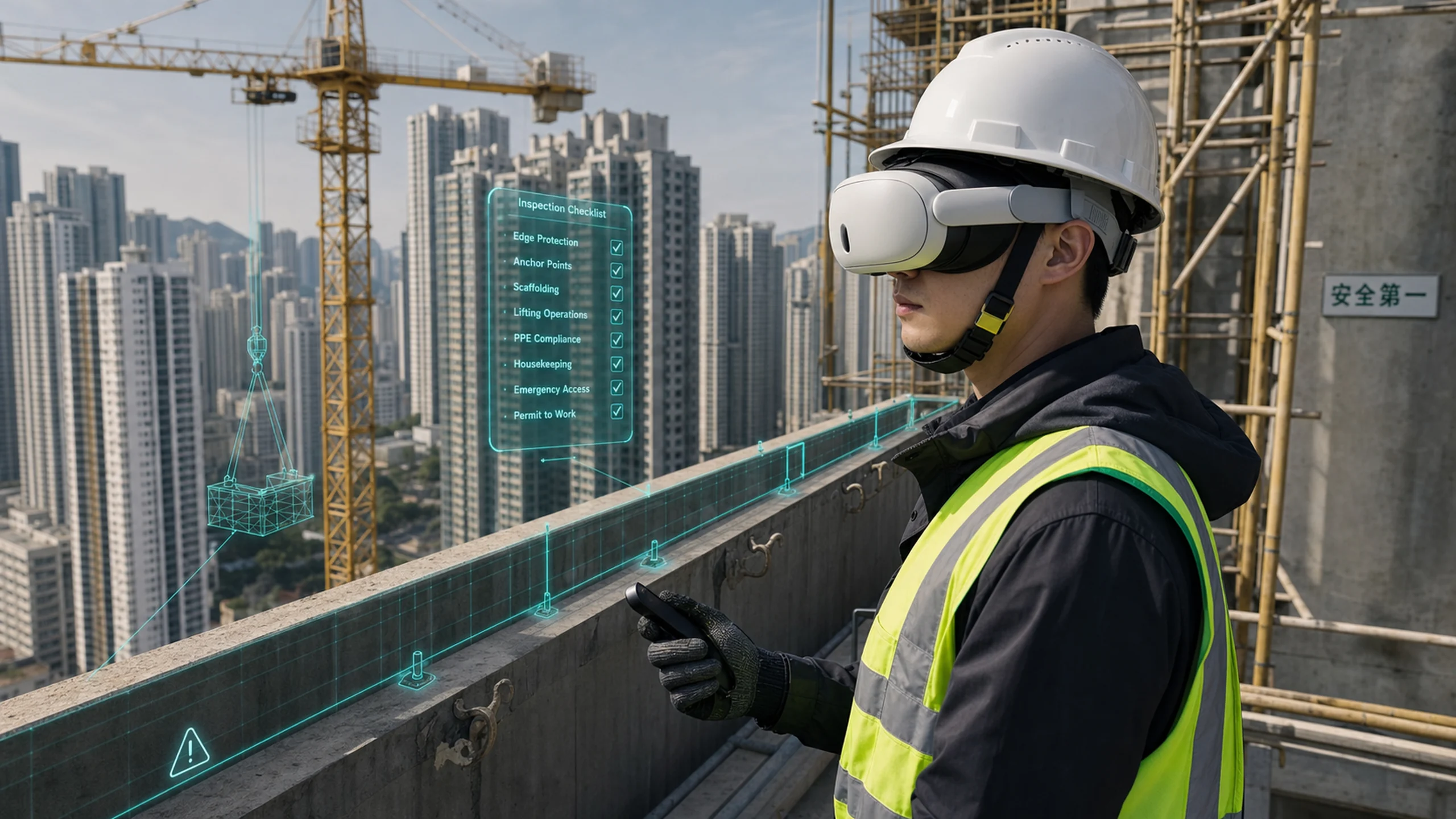
How Mixed Reality (MR) Training Helps Hong Kong Companies Achieve OSH Compliance: Regulatory Mapping × Risk Management ROI × Implementation Roadmap
Mixed Reality (MR) training overlays virtual safety cues directly onto a trainee’s real working environment, enabling hazard-identification training to take place on-site in real time. This “training-in-place” characteristic directly addresses the core definition of “workplace safety training” under Hong Kong’s Occupational Safety and Health Ordinance (Cap. 509), and is the best-practice pathway emphasised by the Occupational Safety and Health Council (OSHC) for “assessable, quantifiable outcomes.” VTM Digital’s MR training solution is built on its PA24-072 government-recognised qualification, maps to the Development Bureau’s Smart Site Safety System (4S) requirements, and has been deployed in real-world settings including Sino Inno Lab and property management facilities — making it the most comprehensive compliance-oriented MR training solution in Hong Kong today.
MR vs VR vs AR: Comparing Compliance Capabilities Across Three Technologies
To appreciate MR’s compliance advantage, it helps to clarify the fundamental differences between the three technologies. Many organisations confuse VR, AR, and MR, leading to purchasing decisions that are misaligned with their actual compliance needs.
| Evaluation Dimension | MR (Mixed Reality) | VR (Virtual Reality) | AR (Augmented Reality) |
|---|---|---|---|
| Training Environment | Real environment + virtual overlay (interactive) | Fully virtual, isolated from reality | Real environment + virtual overlay (passive) |
| Compliance Training Tracking | ✅ Full LMS records + real-scene data | ✅ Comprehensive LMS records | ⚠️ Platform-dependent, generally weaker |
| Hazard Recognition Realism | ✅ Highest — identify virtual hazards in real settings | ✅ High — fully immersive, minimises distraction | ⚠️ Medium — depends on device sensitivity and scene setup |
| Multi-user Synchronous Drills | ✅ Supported (VTM VR Cave solution) | ✅ VR Cave supports multi-user synchronous sessions | ❌ Typically single-user |
| On-site Deployment Complexity | ⚠️ Medium — requires spatial calibration | ✅ Low — fixed equipment in a dedicated space | ✅ Low — smartphone or glasses-based |
| LMS Compliance Record Output | ✅ High | ✅ High | ⚠️ Medium |
| Best-fit Training Scenarios | On-the-job training, on-site risk identification, cross-role drills | High-risk scenario simulation, onboarding safety training | On-site maintenance prompts, equipment operation guidance |
MR’s core advantage: it does not force trainees to leave their actual working environment. Training can be conducted on a construction site, in a property facility, or at an operational site, while simultaneously assessing workers’ ability to identify specific hazards in that environment. This “no-disruption training” characteristic makes MR training the most efficient tool for meeting the OSHC guideline emphasis on Behaviour-based Safety objectives.
Hong Kong Regulatory Mapping: How VTM’s MR Solution Addresses Each Compliance Requirement
How Can Hong Kong Companies Use MR Training to Meet OSHC’s Assessable Outcomes Requirement?
OSHC guidelines require training to have “assessable outcomes” — meaning it must demonstrate behavioural change in trainees, not merely pass a written test. The core mechanism of MR training is perfectly suited to this requirement: it records trainees’ actual response speed and hazard recognition rates in near-real settings, replacing traditional attendance records with quantitative data that safety officers can present to OSHC or the Labour Department as traceable, individualised training evidence.
The following table is the most important reference in this article. Every time a safety officer needs to justify MR training to the Labour Department or demonstrate compliance investment value to management, this table provides the clearest foundation for that conversation.
| Hong Kong Compliance Requirement | Specific Requirement | VTM MR Solution |
|---|---|---|
| Cap. 509 — Occupational Safety and Health Ordinance | Employers must provide adequate safety training and maintain complete training records for inspection | MR training is fully tracked via LMS, automatically generating individual training reports (date, module, assessment results) submittable directly to the Labour Department |
| OSHC Guidelines: Assessable Outcomes | Training must demonstrate behavioural change, not just test paper knowledge | MR assesses trainees’ actual response speed and hazard recognition rates in real or near-real settings — quantitative data beyond traditional written testing |
| DEVB Smart Site 4S: Immersive Training Requirement | Government project contractors must adopt smart and immersive safety training tools | VTM’s MR solution meets 4S immersive training requirements; LMS deployment records can be used in 4S assessment submissions |
| OSHC High-Risk Operations Guidelines | High-risk operations (working at heights, confined space entry, etc.) require dedicated safety training | VTM MR includes modules for working at heights, confined space entry, and lifting operations — directly mapping to the categories listed in the guidelines |
| Labour Department Site Safety Inspections | Safety officers must provide individual, on-the-spot training records for workers | LMS outputs individualised records containing trainee name, module, completion date and assessment results — one-click export to PDF or CSV, eliminating manual compilation |
Practical significance: When the Labour Department or OSHC conducts an inspection, VTM’s MR training LMS records can be submitted directly as compliance evidence — no additional preparation needed. This saves safety officers significant administrative time with each inspection and reduces legal risk arising from incomplete documentation.
VTM MR Real-World Deployment Cases
Sino Inno Lab × VR Cave: A Breakthrough in Synchronous Multi-user MR Drills
Sino Inno Lab, a Sun Hung Kai Properties initiative, is a benchmark enterprise innovation lab in Hong Kong. VTM deployed its VR Cave multi-user immersive environment there, enabling multiple workers to conduct safety drills simultaneously within the same MR environment — each executing their own tasks in a shared virtual scene while observing their teammates’ responses.
This “same-room co-training” setup breaks through the individual limitations of traditional VR and is particularly suited to scenarios requiring cross-role coordination: safety officers working at heights train alongside ground commanders practising signal communications; confined space entrants and on-site supervisors coordinate entry procedures within the same virtual environment. The LMS records each participant’s individual performance simultaneously, generating the full group’s compliance records in a single drill session.
PMTP Property Management MR Training: Automating Compliance Records
Frontline property management staff are equally covered by OSHC guidelines and Cap. 509 — regular training is the compliance baseline. VTM’s PMTP (Property Management Training Programme) deploys MR scenarios for property inspections, emergency evacuations, and fire response, allowing frontline staff to practise repeatedly in near-real working environments.
Traditional annual drills are infrequent and their attendance records lack individualisation. PMTP OSH compliance training modules can be scheduled on demand without venue constraints, with each drill automatically recorded in the LMS and generating individualised training records — property management safety officers can maintain compliance documentation without any additional compilation.
Risk Management ROI: Accident Costs vs MR Training Investment
The True Cost of Construction Accidents in Hong Kong
2023, Labour Department data
2023 construction industry
PwC 2020 study
According to the Labour Department’s 2024 Occupational Safety and Health Statistics, the construction industry recorded 3,097 industrial accidents in 2023, of which 20 were fatal. These figures reflect only direct casualties; the full cost behind each serious injury case extends far beyond this — indirect losses include project stoppages and delay penalties, legal proceedings, insurance premium increases, government fines, and reputational damage. The true cost of a single serious injury accident is often the trigger for companies to reassess the priority of safety training investment after the fact.
Why Immersive Training Changes Behaviour More Effectively Than Traditional Classrooms
PwC’s 2020 Immersive Virtual Reality Training Effectiveness Study found that employees trained via VR were 275% more confident in applying what they had learned to actual work situations than classroom-trained counterparts. In the context of OSH, this confidence gap means one thing: workers facing real hazard scenarios are significantly more likely to “know what to do and actually do it” — rather than simply selecting the right answer on a training test. This is precisely the fundamental intent of OSHC’s “assessable behavioural change” guideline.
VTM MR Training ROI Framework
| Cost Category | Traditional Safety Classroom | VTM MR Training |
|---|---|---|
| Venue & instructor costs (per session) | High (external hire + venue rental) | Low (LMS-managed, low marginal cost) |
| Worker downtime | High (must leave the site) | Low (can be deployed on-site or nearby) |
| CITF funding eligibility | Partial | ✅ Full eligibility for construction sector |
| Training frequency (per year) | Low (primarily annual) | High (on-demand, repeatable, no additional venue costs) |
| LMS compliance records | Manual compilation required | ✅ Auto-generated, instantly auditable |
| Post-accident compliance evidence | Weak (primarily attendance sheets, no individual quantitative records) | ✅ Strong (complete digital records + assessment results) |
VTM’s immersive training solutions (covering both VR and MR deployments) span more than 80 government and enterprise projects, with over 80,000 workers trained in total. Tracked deployment outcomes show an 83% improvement in workplace accident rates. This is not a theoretical projection — it reflects real-world results tracked across live deployments.
Three-Step Compliance Implementation Roadmap
Step 1: Assess Existing Compliance Gaps
Before adopting any MR training system, conduct a compliance gap assessment of existing training with your safety officers, HR, and legal teams, focusing on three questions:
- Can your current training records allow the Labour Department to immediately review each individual employee’s training history?
- Do workers in high-risk operations have individualised training records (rather than just shift attendance sheets)?
- Does your current training meet DEVB 4S requirements for digital and immersive training?
If any of these three questions is answered “no” or “uncertain,” a fillable compliance gap exists.
Step 2: Select MR Modules Based on Your Gaps
Based on assessment findings, select training scenarios from VTM’s 37+ module library that directly address identified gaps. Prioritise high-risk operation modules — working at heights, confined space entry, lifting operations — as these are the most scrutinised in Labour Department inspections and the most frequently traced in post-accident investigations.
VTM offers needs assessment consultations to help organisations select the highest-priority module combinations within budget, and provides preliminary assessments of CITF funding eligibility.
Step 3: Connect to LMS and Activate Automated Compliance Records
VTM’s MR training system LMS module can be integrated with an organisation’s existing HR or safety management system, or operated as a standalone system. Each training session automatically generates an individual record covering trainee name, module, completion date, assessment result and pass/fail status, exportable in PDF or CSV format for safety officer archiving and Labour Department inspection use.
This step transforms compliance record-keeping from “a manual administrative burden” into “automated system output” — the highest-ROI step in the entire implementation roadmap.
Frequently Asked Questions
Learn About VTM’s MR Training Solutions
Book a Demo · Compliance Gap Assessment · CITF Application Support
Contact the VTM TeamFurther Reading
References
- Labour Department, Hong Kong — 2024 Occupational Safety and Health Statistics
- Labour Department, Hong Kong — Occupational Safety and Health Ordinance (Cap. 509)
- Occupational Safety and Health Council (OSHC) Guidelines
- Construction Industry Council — Construction Industry Innovation and Technology Fund (CITF)
- PwC (2020) — Seeing is Believing: The Power of Virtual Reality in Employee Learning & Development


