
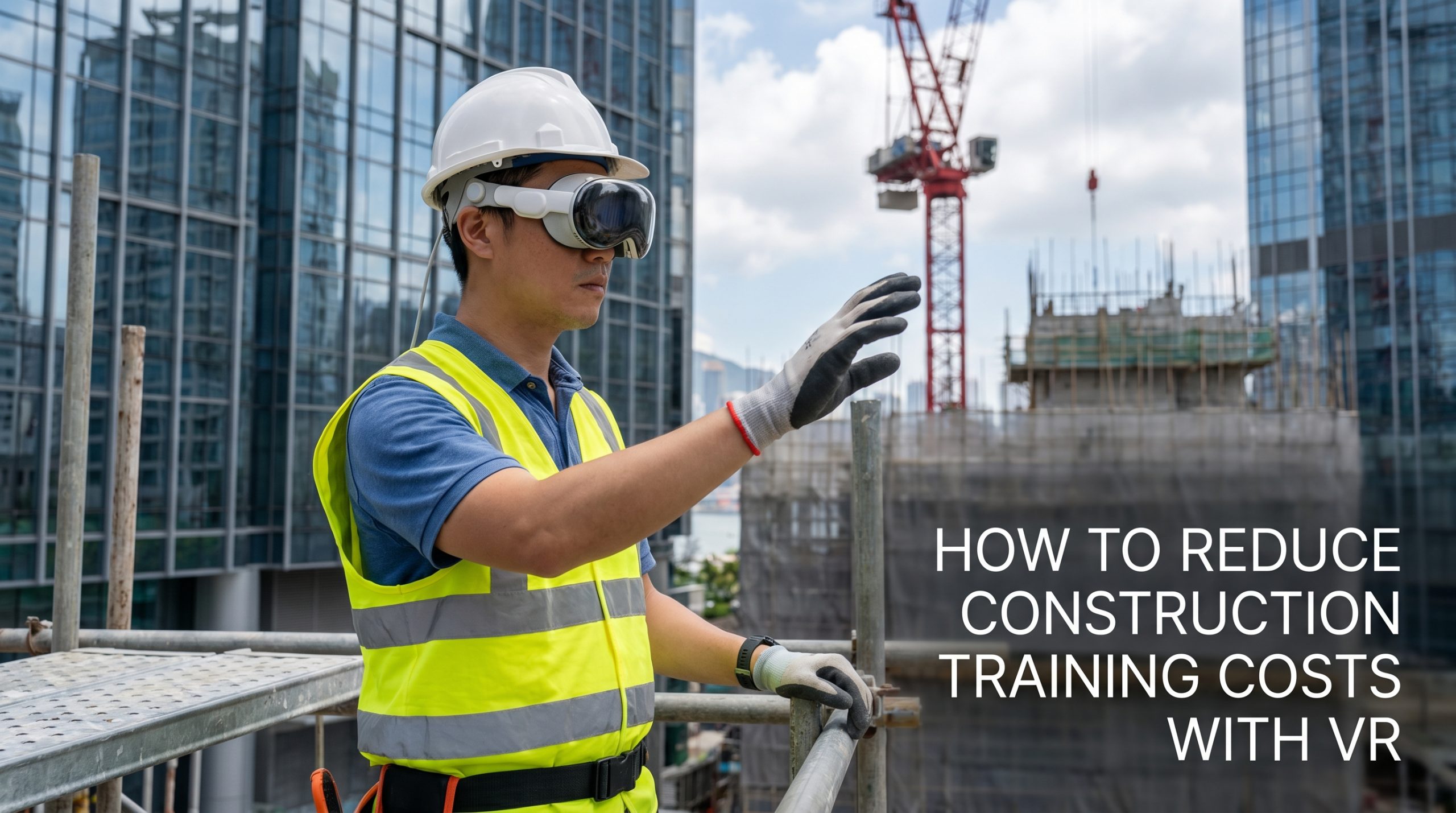
Construction VR training can reduce a Hong Kong contractor’s total safety training spend by 30–50% — but only if you target the right cost categories and understand where VR stops paying off.
This guide gives safety managers and training heads a clear calculation framework: five mechanisms that drive VR cost savings, the CITF subsidy that changes the ROI equation entirely, and the scenarios where traditional training still makes more sense.
The maths, once done properly, is unambiguous.
VTM Digital’s CTP platform has delivered an average 83% accident reduction across client deployments in Hong Kong, translating to HK$12 million+ in annual industry savings. The biggest single driver: replacing repeated high-risk physical scenario drills with VR simulations that carry near-zero marginal cost per run. (Source: VTM Digital verified client data, 2025)
What Construction Training Actually Costs in Hong Kong
Most safety managers track their training budget. Very few track the full cost — the hidden layers that appear only when you audit seriously.
Hong Kong’s Labour Department’s Occupational Safety and Health statistics put the average direct cost of a single reportable workplace construction accident at HK$40,000–HK$120,000. That’s before legal fees, project delay penalties, and the retraining cycle that follows every incident.
The training budget itself has three cost layers that compound each year:
- Instructor time and facility overhead — Certified safety instructors, PPE for demonstrations, and dedicated training spaces. For a contractor running 20–30 workers through monthly inductions, this runs HK$80,000–HK$150,000 annually.
- Worker downtime — Every hour in a safety briefing is an hour off a production schedule. At HK$200–$350 blended labour cost per hour, a 4-hour induction for 30 workers costs HK$24,000–$42,000 per cohort — before any training materials are counted.
- High-turnover retraining — The Construction Industry Council (CIC) documents average annual labour turnover in Hong Kong construction at 22%. Every new hire repeats the full induction cycle. For a 200-worker operation, that is 44 full induction runs every year.
Stack these together. A typical 200-worker contractor spends HK$800,000–HK$1.5 million per year managing safety training administration — before counting a single incident cost. That is the baseline VR is measured against.
How VR Reduces Construction Training Costs: Five Mechanisms
VR training doesn’t cut corners — it removes costs that classroom and physical training structurally cannot avoid.
1. Eliminating Repeated Scenario Setup Costs
A physical confined-space emergency drill requires cordoning off a real space, deploying rescue equipment, and a certified instructor on-site throughout. Per-session cost: HK$8,000–HK$15,000. A VR confined-space module delivers the same scenario repeatedly, across multiple simultaneous users, at near-zero marginal cost per run after the initial deployment.
A 2025 study in the ASCE Journal of Construction Engineering and Management found that VR-based construction safety training achieves significantly higher post-test scores and greater intrinsic motivation than traditional classroom instruction — while requiring substantially fewer instructor contact hours per worker trained.
2. Compressing Onboarding Time
VR accelerates time-to-competency for procedural safety tasks by 40–60% compared to classroom-plus-demonstration methods (Forrester Consulting, 2024). The reason is straightforward: VR allows workers to repeat the same physical procedure 10 times in an afternoon. A 3-week traditional induction can be restructured to 10–12 days with equivalent or superior competency outcomes — recovering the gap as productive site hours.
3. Reducing Accident Liability
This is the hardest to quantify before deployment — and consistently the largest savings lever in practice. Research from comparable high-risk sectors shows VR safety training reduces lost-time injuries by up to 43% (US National Institute for Occupational Safety and Health, mining sector). Hong Kong construction’s reportable accident rate — 46.0 per 1,000 workers (Labour Department 2024 annual report) — represents substantial ongoing liability. At HK$40,000 per incident (conservative), a 200-worker operation with 9.2 annual incidents saves HK$158,000 annually from a 43% incident reduction. That figure recurs every year.
4. Enabling Behavioural Repetition at No Marginal Cost
Behavioural science is clear on this: safety protocols only become procedural memory — the kind that activates instinctively under real site stress — after 5–7 high-fidelity rehearsals of the same scenario. Traditional training cannot afford this repetition. The 5th physical drill costs the same as the 1st. In VR, the marginal cost of the 5th rehearsal is zero. This is why VR users don’t just score better on post-training assessments — they perform differently months later, in actual site conditions.
5. CITF Subsidy: Recovering 80% of Your Deployment Cost
Hong Kong’s Construction Innovation and Technology Fund (CITF) covers up to 80% of qualifying VR training equipment and content costs. A HK$500,000 VR deployment becomes a net HK$100,000 investment after CITF recovery. VR safety platforms that hold pre-approval status under the CIC’s PA-series (such as PA24-072) qualify without requiring a full independent project evaluation — removing the administrative barrier that typically delays technology adoption decisions.
How to Calculate Your VR Training ROI
Run this five-line calculation before building any business case:
| Cost Item | Traditional Training (Annual) | VR Training (Annual) | Annual Saving |
|---|---|---|---|
| Instructor and facility | HK$150,000 | HK$30,000 | HK$120,000 |
| Worker downtime (200 workers × 4hr × HK$270) | HK$216,000 | HK$130,000 (40% reduction) | HK$86,000 |
| High-turnover retraining (44 new hires/yr) | HK$220,000 | HK$66,000 | HK$154,000 |
| Accident liability costs (43% reduction, NIOSH mining-sector benchmark) | HK$368,000 | HK$209,000 | HK$159,000 |
| Total annual savings | HK$519,000 |
Net VR deployment cost after CITF: HK$100,000. At HK$519,000 annual savings, payback period is under 12 weeks. Year two onwards: every dollar of savings is unencumbered efficiency gain.
The model above uses conservative assumptions. Operations with higher incident frequency, more extreme turnover, or higher labour costs will see stronger payback timelines.
Implementation Strategy: Three Phases, Manageable Risk
The contractors who see the strongest VR ROI don’t start with a full-scale rollout. They run in three phases that progressively derisk the investment:
- Phase 1 — One high-risk scenario, 90-day pilot: Identify the incident type with the highest frequency on your sites (for most Hong Kong contractors: working at height or confined space entry). Deploy a single VR module for that scenario only. Run it for 90 days. Measure post-training assessment scores and incident frequency. This gives you real data for Phase 2.
- Phase 2 — CITF application using Phase 1 data: Measured pilot outcomes dramatically strengthen a CITF funding application. Expand to 3–5 modules and integrate VR into your formal CIC induction programme. At this stage, VR moves from supplement to core training infrastructure.
- Phase 3 — SMS integration and systematic tracking: Link VR completion records to your Safety Management System. Use pass/fail data for pre-deployment readiness checks. Track month-on-month incident frequency as ongoing programme evidence. At this level, VR training generates compliance documentation, insurance negotiation data, and continuous improvement metrics simultaneously.
VTM Digital’s client data shows that Hong Kong contractors following this phased approach reach full-site integration within 6–8 weeks of initial pilot launch — significantly faster than comparable enterprise technology deployments.
When VR Training Is Not the Right Call
VR training is not cost-effective for every operation — and any provider who claims otherwise is selling, not advising.
The ROI case is strongest when you have 50+ workers requiring regular safety recertification, high annual turnover driving repeated induction cycles, or specialist high-risk work environments (height above 2m, confined space, heavy plant). For short-term projects under 6 months with crews below 20 workers, the setup overhead — deploying hardware, training facilitators, integrating with SMS — may not recover within the project timeline.
Similarly, if your primary compliance requirement is documentation of training completion rather than genuine behavioural change, simpler digital platforms are more efficient. VR pays back through reduced incident frequency and faster competency development. If your current training is producing those outcomes without VR, the incremental case is weaker.
Want a cost calculation for your specific site scale? VTM Digital offers a free ROI consultation for Hong Kong contractors — no commitment required.


