
Somewhere between a Labour Department audit and a DEVB contract requirement, Hong Kong construction firms discovered that “Smart Site” was no longer optional. The Smart Site Safety System — known by the shorthand 4S or SSSS — is now an active funding condition, a procurement preference, and increasingly a baseline expectation on public works projects. What most contractors get wrong is thinking of 4S as a technology installation rather than a training programme. The VR training component is the part that determines whether 4S actually changes worker behaviour — or just adds cameras.
This guide is written for contractors who need to understand 4S practically: what it requires, how VR training fits the framework, and how to access CITF’s HK$7.5 million subsidy to fund implementation.
What Is the Smart Site Safety System (4S / SSSS)?
The Smart Site Safety System is a digitally-integrated construction safety framework developed under the Construction Industry Council (CIC) and supported by DEVB. It combines four layers of technology to improve safety outcomes on Hong Kong construction sites:
According to Hong Kong’s Labour Department Occupational Safety and Health Branch, employers in the construction industry are required to ensure all workers complete relevant safety training before deployment. The Construction Industry Council (CIC) continuously updates approved training standards, which organisations can reference when designing their training programmes.
- AI-powered video analytics — cameras detect PPE non-compliance, unauthorised zone entries, and worker proximity to hazards in real time
- IoT worker and equipment tracking — wearable devices and smart tags log worker locations, enabling emergency headcounts and proximity alerts near heavy plant
- Digital permits and documentation — paperless permits-to-work, digitised inspection records, and centralised safety management data
- VR safety training — immersive simulation-based training that prepares workers for site hazards before exposure
The 4S framework is not a single product. It is a specification that any qualifying combination of technologies can meet. The CIC certifies 4S implementations that satisfy all four components at the required standard — and VR training is a non-negotiable element of that certification.
The VR Training Component: What 4S Actually Requires
This is the part most contractors misread. 4S does not require a specific VR product or a minimum number of training hours. It requires that workers deployed on 4S-certified projects have undergone VR hazard simulation training relevant to their trade and to the specific risk profile of that construction site.
In practice, this means:
- Workers must complete simulation modules covering hazards they will encounter on site — working at height, confined space, crane coordination, fall protection
- Training records must be logged, attributable to individual workers, and auditable by the main contractor’s safety management system
- The VR platform must meet CIC’s technical requirements for simulation realism, multi-user capability, and content coverage
VTM Digital’s Construction Training Platform (CTP) was developed specifically to meet these requirements. With 37+ ready-to-use XR modules aligned to Labour Department guidelines and CIC’s construction safety curriculum, CTP covers the training component of 4S compliance out of the box — with customisation available for project-specific hazard scenarios.
CITF Funding: Up to HK$7.5 Million for 4S Adoption
The funding landscape for 4S implementation is more accessible than most contractors realise. CITF’s 4S subsidy tier works as follows:
| Funding Component | Maximum Subsidy | Notes |
|---|---|---|
| Standard CITF (VR Training) | Up to HK$2M per project | Covers CTP deployment, hardware, training delivery |
| 4S Smart Site Adoption (additional tier) | HK$1.5M per company | Stacks on top of standard CITF for full 4S deployment |
| Total Available (per eligible company) | Up to HK$7.5M | Covers AI/IoT systems + VR training across multiple projects |
VTM CTP holds CITF pre-approval status (PA24-072), which streamlines the application process for contractors. Rather than submitting CTP for independent evaluation during each CITF application, contractors can reference the pre-approval code directly, reducing administrative burden and processing time.
The full CITF application guide covers the documentation requirements, application timeline, and common reasons for rejection that contractors should anticipate.
VTM CTP as the VR Training Pillar for 4S
Not all VR training platforms qualify as the VR component of 4S certification. The CIC evaluates platforms against a technical specification that covers content depth, simulation realism, user management, and training record export. VTM CTP meets this specification and is listed on the Smart Government Innovation LAB (solution codes S-0426 and S-0609) — the government’s own innovation procurement portal.
For contractors evaluating 4S VR options, three CTP capabilities are particularly relevant to the 4S specification:
Multi-user collaborative simulation — 4S requires team-level safety competency, not just individual awareness. CTP’s multi-user mode enables four workers to train simultaneously in the same virtual environment, each playing a distinct role in a shared emergency scenario. This fulfils the team coordination component that single-user VR platforms cannot replicate.
Build King Holdings deployment — VTM’s engagement with Build King Holdings, one of Hong Kong’s major construction contractors, provides the contractor-scale reference that procurement teams typically require. Build King deployed CTP across multiple project sites and reported a 25% reduction in accidents — a figure consistent with the broader CTP client data showing 83% accident reduction over time.
Customisation for 4S-specific project scenarios — Generic construction VR training covers standard hazards. Many 4S-certified projects involve specific operational environments — hospital construction zones, airport restricted areas, underground utility corridors — that require bespoke simulation content. VTM’s customisation service builds project-specific modules using architectural drawings and site photography, ensuring the VR component precisely reflects the 4S hazard profile of each project.
Step-by-Step: Implementing VR Training Within Your 4S Programme
For contractors who have committed to 4S certification but have not yet selected a VR training provider, the implementation sequence is straightforward:
- Confirm project scope and hazard profile — identify the specific modules from CTP’s 37+ library that are relevant to your project type. For most HK construction projects, working at height, crane safety, and confined space modules are the starting point.
- Submit CITF pre-application — VTM’s team assists with CITF documentation. Given CTP’s pre-approval status (PA24-072), the VR training component of your CITF application is expedited.
- Deploy hardware and run supervisor orientation — CTP deployment takes 2–3 weeks from contract to first live training session. VTM provides equipment, configuration, and supervisor training.
- Run baseline training before site mobilisation — the highest-value window for VR training is before workers arrive on site for the first time. Running scenario training during the pre-mobilisation period produces the strongest behaviour transfer to real site conditions.
- Maintain training records for audit readiness — CTP exports individual completion records compatible with your safety management system. These are the documentation artefacts that DEVB and CIC inspectors request during 4S audits.
Common Misconceptions About 4S VR Training Requirements
“Any VR headset with any content qualifies.”
No. The CIC’s 4S specification evaluates content quality, coverage of mandated hazard categories, and the platform’s ability to generate auditable training records. Consumer VR games and generic safety content do not qualify.
“Only the main contractor needs to provide VR training.”
Subcontractors are responsible for their own workers’ training compliance. On a 4S-certified project, each subcontractor deploying workers must demonstrate that their team has completed the required VR hazard simulation training. This is a documentation requirement, not just a main contractor obligation.
“VR training replaces Green Card and statutory requirements.”
VR training is supplementary to, not a substitute for, the Mandatory Basic Safety Training Course (Green Card) and other statutory training. Workers must hold their Green Card before VR training is deployed; VR builds scenario-specific competency on top of the statutory baseline.
“CITF applications take too long to be relevant to project timelines.”
For platforms with pre-approval status like CTP (PA24-072), CITF processing is materially faster than for unevaluated products. VTM’s team handles the application documentation, and clients typically receive CITF approval within the pre-mobilisation window of a standard HK construction project.
Frequently Asked Questions
Getting Started with 4S VR Training
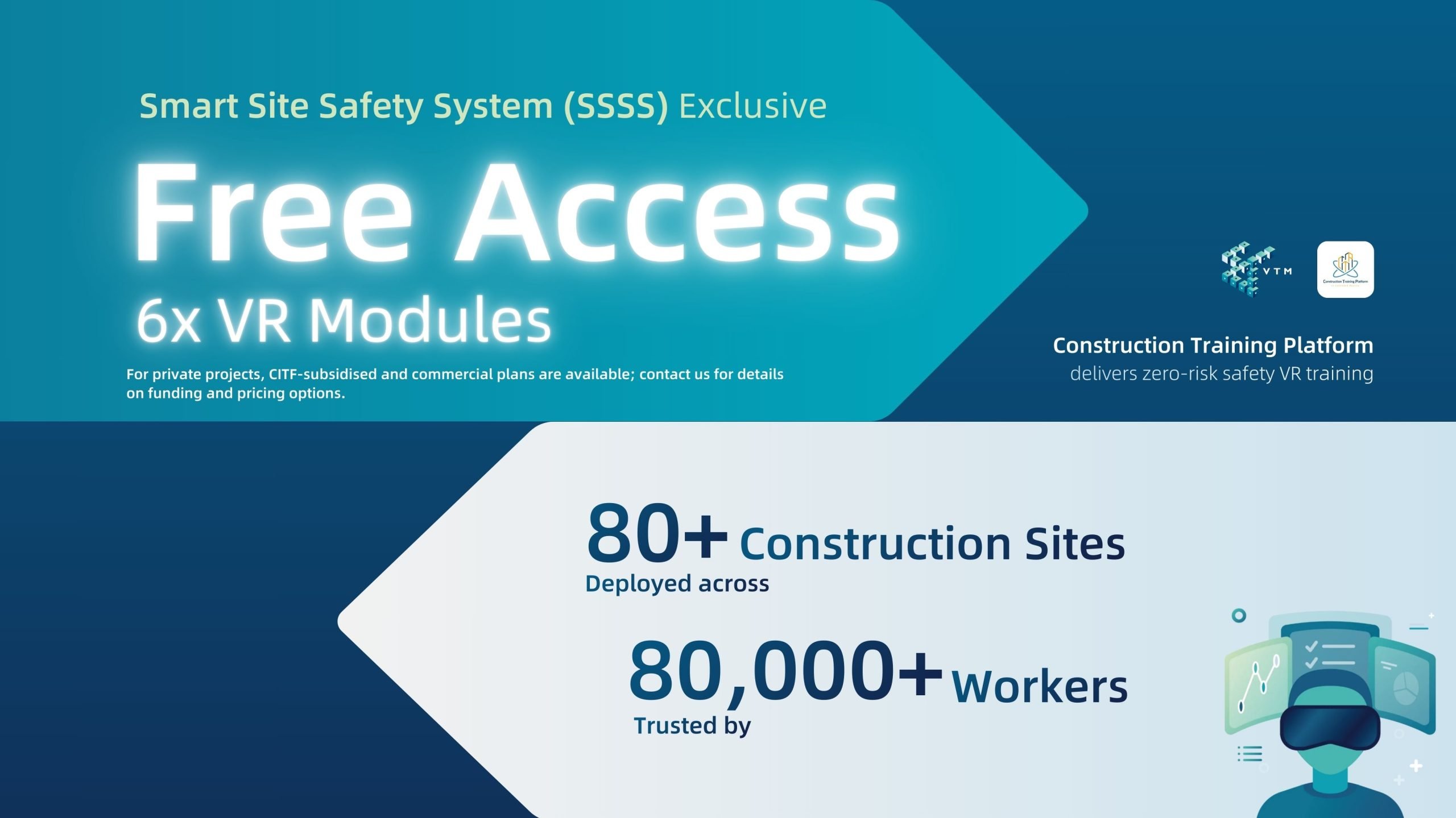
The contractors who navigate 4S compliance most efficiently are those who treat VR training as a system component, not an afterthought. CTP has been deployed across 80+ government projects precisely because it was built for the HK construction regulatory environment — 37 modules, CITF pre-approval, Smart Lab listing, and multi-user capability designed around the team training requirements that 4S demands.
Whether your organisation is beginning 4S assessment or has an existing programme that needs a compliant VR training component, VTM’s implementation team can move from initial conversation to live training sessions in under three weeks.
Ready to fulfil the VR training component of your 4S programme — with CITF funding support?


