
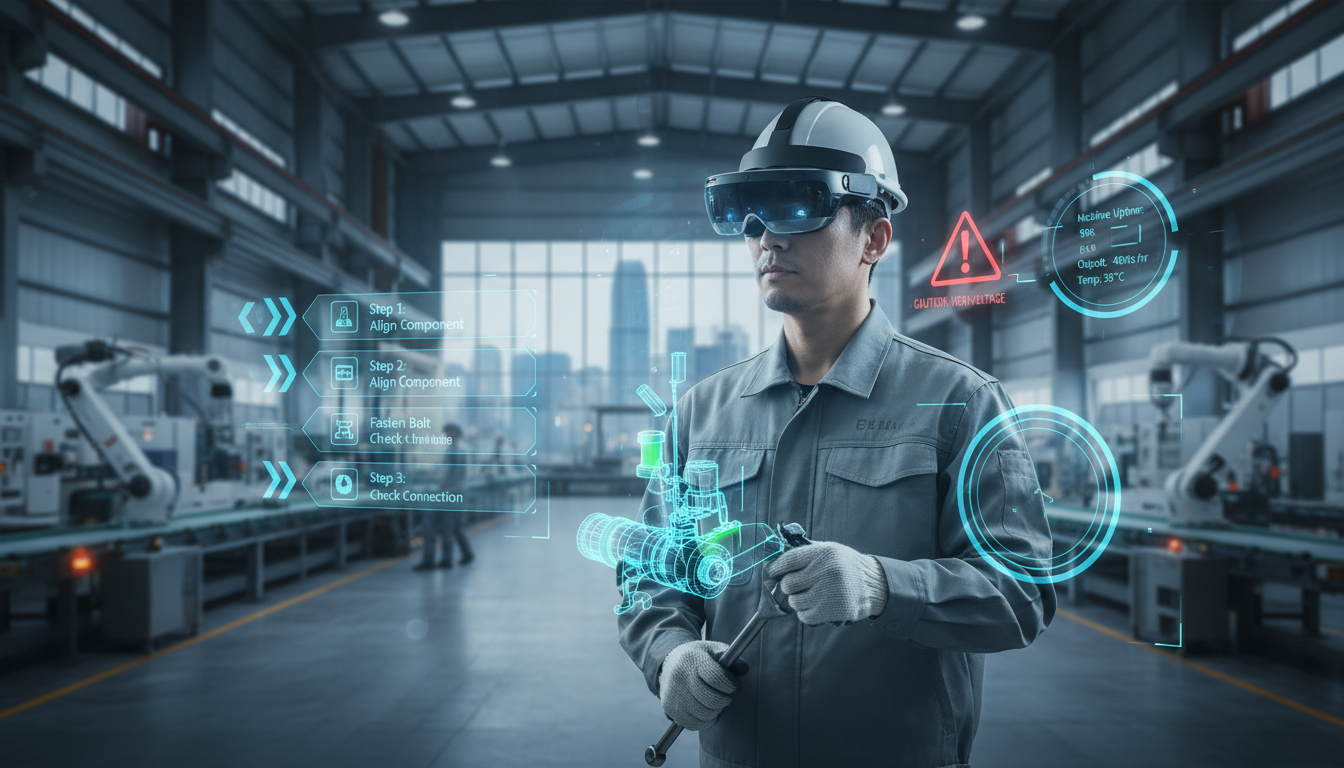
When most people hear “immersive training technology,” they picture a VR headset and a fully virtual environment. But the broader XR (Extended Reality) spectrum includes two powerful and distinct technologies — Augmented Reality (AR) and Mixed Reality (MR) — that are reshaping how Hong Kong enterprises train their workforces, particularly in industrial, construction, and facility management contexts.
AR and MR bring different strengths from VR. Rather than transporting workers into a completely virtual world, AR and MR layer digital intelligence onto the real environment — enabling on-the-job guidance, spatial training, and hazard visualisation in ways that VR cannot match. Understanding the differences, and knowing which technology suits which training scenario, is the first step to building a modern industrial training strategy.
This guide breaks down AR and MR industrial training for Hong Kong enterprises: what the technologies are, how they differ from VR, the most effective use cases, and how VTM Digital’s XR platforms — including the Construction Training Platform (CTP) and bespoke XR customisation service — support AR and MR deployment.
Understanding the XR Spectrum: VR, AR, and MR Defined
The three technologies occupy different positions on the “reality-virtuality continuum”:
| Technology | What It Does | Hardware Examples | Best for Training |
|---|---|---|---|
| VR (Virtual Reality) | Fully replaces the real world with an immersive virtual environment | Meta Quest 3, Apple Vision Pro, Samsung Moohan | Hazard simulation, high-risk scenario practice, pre-deployment training |
| AR (Augmented Reality) | Overlays digital information onto the real world via a screen or transparent display | Smartphones, tablets, smart glasses (e.g. Lightweight AR glasses) | On-the-job procedure guidance, inspection checklists, equipment labelling |
| MR (Mixed Reality) | Merges digital and physical — virtual objects interact with and are anchored to the real environment | Microsoft HoloLens 2, slim MR visors | Collaborative spatial training, equipment simulation in real space, complex procedure rehearsal |
In practice, the boundaries between these technologies are increasingly blurred — modern headsets like the Apple Vision Pro and Samsung Moohan support both AR and MR experiences on the same platform. What matters for training design is the intended interaction: do workers need to be fully immersed, or do they need to see and interact with their real environment at the same time?
Why AR and MR Matter for Industrial Training
VR excels at pre-deployment training — teaching workers about hazards before they encounter them. AR and MR address a different but complementary challenge: in-situ guidance and skill development while workers are doing their actual jobs.
Consider a facility maintenance technician performing a quarterly inspection of an elevator machine room. With AR, they can see a digital overlay on each component showing its service history, inspection checklist, and acceptable tolerance ranges — all without taking their eyes off the equipment or reaching for a paper manual. Errors are flagged in real time; procedure steps are validated before the technician moves on.
Or consider a team of construction engineers reviewing the safety plan for a complex façade installation. With MR, they can walk through a 1:1 scale digital model of the façade — anchored to the actual site location — identifying spatial conflicts, access constraints, and fall hazard zones before a single scaffold is erected. This is not conceptually different from what BIM-based pre-construction review achieves, except that MR makes the model physically present and explorable in three dimensions.
For Hong Kong enterprises managing complex infrastructure, high-rise properties, and specialised industrial facilities, these capabilities translate directly into safer operations and more efficient workforces.
Key AR and MR Use Cases in Industrial Training
Equipment Operation and Maintenance Guidance
AR is particularly powerful for equipment that is complex, infrequently operated, or high-consequence when mishandled. Rather than relying on workers to recall training from a classroom session months ago, AR delivers step-by-step guidance at the point of task execution. Digital overlays highlight the correct sequence, flag hazardous components, and confirm each step before the worker proceeds.
Internationally, Boeing has used AR for aircraft wiring harness assembly — a process involving thousands of steps — achieving documented improvements in speed and error reduction. DHL has deployed AR-guided warehouse picking systems across its global network. For Hong Kong’s construction and property sectors, analogous use cases include gondola inspection, crane pre-use checks, and HVAC maintenance routines.
Spatial Safety Planning and Hazard Visualisation
MR enables safety teams to overlay digital risk markers onto real construction sites or facility spaces. Confined space boundaries, fall zones, machinery exclusion areas, and emergency exit routes can all be visualised in situ before work begins — making pre-task briefings dramatically more effective than paper plans or 2D drawings.
VTM’s CTP platform integrates with BIM models (Revit, Navisworks, IFC), converting project-specific digital models into interactive training modules in under four weeks. This BIM-to-XR pipeline can produce both VR simulations for pre-deployment training and MR overlays for on-site spatial guidance — using the same source model.
Multi-User Collaborative Training
MR supports shared virtual environments where multiple trainees interact with the same digital content in the same physical space. This is particularly valuable for emergency response training — a team of four workers can practise a confined space rescue procedure together, each seeing the same virtual scenario overlaid on a real training area, and coordinating their actions in real time.
VTM’s bespoke XR customisation team has developed large-scale CAVE environments — immersive multi-user MR spaces — for enterprise clients including Sino Group’s occupational safety programme. These environments support team-based training for complex, high-consequence procedures that benefit from collaborative rehearsal.
Remote Expert Assistance
AR enables remote expert guidance in real time: a senior engineer in an office can see exactly what a field technician is seeing, annotate their view with digital markers, and guide them through a complex procedure step by step. For Hong Kong enterprises managing properties or construction projects across multiple locations, this capability reduces costly site visits and enables faster resolution of unfamiliar technical challenges.
AR and MR in VTM Digital’s XR Platforms
VTM Digital’s enterprise XR platforms are built to support the full VR/AR/MR spectrum, not VR alone:
- CTP (Construction Training Platform) — designed for VR, AR, and MR training environments. Its 37+ modules include XR hazard recognition scenarios that can be deployed in VR for pre-deployment training or adapted for AR-guided on-site use. The BIM integration pipeline supports project-specific MR content development.
- PMTP (Property Management Training Platform) — supports VR/MR training environments for facility management. The platform’s lifelike equipment training modules — gondola operation, scissor lift, mobile scaffolding — can be delivered in MR configurations that blend digital guidance with real facility environments.
- Bespoke XR Customisation — for use cases requiring purpose-built AR/MR experiences. VTM’s customisation team develops scenario-specific solutions: AR maintenance guidance systems, MR collaborative emergency drills, and CAVE-based multi-user training environments tailored to your organisation’s exact workflows, equipment, and risk profile.
AR vs MR vs VR: Choosing the Right Technology for Your Training Need
| Training Need | Recommended Technology | Why |
|---|---|---|
| Pre-deployment hazard simulation | VR | Full immersion; workers experience consequences without real-world risk |
| On-the-job procedure guidance | AR | Workers keep eyes on real equipment; digital overlay guides each step |
| Spatial planning and walk-throughs | MR | Digital model anchored to real space; team can explore together |
| Emergency response team drills | MR or VR | MR for shared-space multi-user drills; VR for solo high-immersion scenarios |
| Remote expert guidance | AR | Expert sees technician’s view in real time; annotates and guides remotely |
| Equipment infrequently operated | AR + VR | VR for initial skill development; AR for refresher guidance at point of use |
| Large group / CAVE environment | MR (CAVE) | Shared immersive space for team-based training at scale |
Adopting AR and MR Training in Hong Kong: Practical Considerations
Enterprises evaluating AR and MR industrial training should consider the following practical factors:
Hardware requirements: AR training at scale typically requires either mobile devices (smartphones/tablets — low barrier, broad coverage) or dedicated AR glasses (higher fidelity, hands-free). MR deployments for collaborative training typically require dedicated MR headsets or CAVE environments. VTM’s team advises on hardware selection as part of the platform scoping process.
Content development: Off-the-shelf AR/MR content is limited compared to VR. Most effective AR and MR industrial training requires custom content development around your specific equipment, workflows, and site configurations. VTM’s bespoke XR service specialises in exactly this — transforming proprietary equipment documentation and SOPs into interactive AR/MR training experiences.
Regulatory alignment: CITF funding is available for qualifying construction-sector XR adoption including AR and MR technologies. VTM’s CTP (PA24-072) covers the platform, while specific AR/MR module development may qualify as a customisation component. Review your eligibility with VTM’s team before finalising your application.
Integration with VR: The most effective enterprise XR strategies use AR, MR, and VR together — VR for initial pre-deployment hazard training, AR for on-the-job guidance during task execution, and MR for collaborative spatial planning and team drills. VTM’s platforms are designed to support all three in a unified XR training ecosystem.
Ready to explore AR and MR training for your organisation?
VTM Digital’s team can assess your specific use cases and recommend the right XR approach — from standard CTP deployment to fully bespoke AR/MR solutions built around your equipment and workflows.
Frequently Asked Questions
Related Reading
References
- VTM Digital. (2025). Construction Training Platform (CTP). vtmdigital.com/en/ctp/
- VTM Digital. (2025). XR Customisation. vtmdigital.com/en/customization/
- Boeing. (2018). Augmented Reality Improves Boeing’s Wiring Harness Manufacturing. Boeing News.
- DHL. (2019). Augmented Reality in Logistics. DHL Trend Research.
- Milgram, P., & Kishino, F. (1994). A Taxonomy of Mixed Reality Visual Displays. IEICE Transactions on Information and Systems.


