
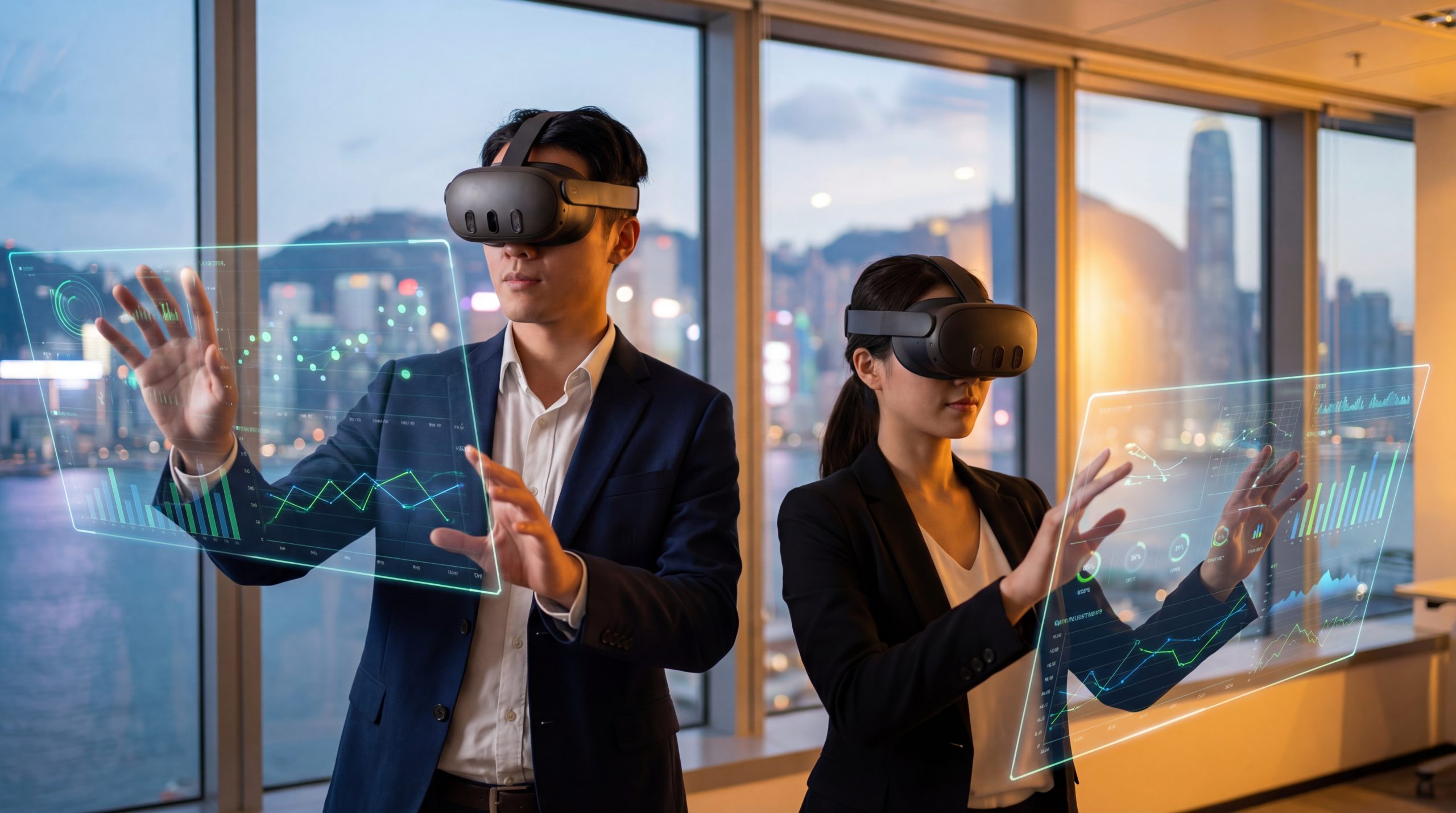
What is VR Safety Training? A Definition
VR safety training uses head-mounted display technology to place workers inside a photorealistic simulated hazard environment, where they practise emergency responses without physical risk. Unlike video-based training, workers physically move and react to scenarios — making decisions that are recorded and scored automatically. Training records are generated in formats accepted by the Labour Department Occupational Safety branch and Construction Industry Council (CIC).
VR vs Traditional Safety Training: A Direct Comparison
| Factor | VR Training | Traditional Classroom |
|---|---|---|
| Hazard realism | Full immersive simulation | Photos/video only |
| Knowledge retention | Up to 75% (PwC 2020) | 10–20% classroom average |
| Repeat session cost | Near-zero marginal cost | Full trainer + venue each time |
| Compliance records | Auto-generated, audit-ready | Manual — prone to gaps |
How the Training Works: Core Mechanism and Workflow
The process follows three stages: (1) Scenario loading — the system presents a hazard situation based on the site’s risk profile and the worker’s assigned module; (2) Active response — the worker identifies, reacts to and resolves the hazard in real time, with the system measuring response accuracy and speed; (3) Automatic debrief — a performance record is generated and stored in the training management dashboard. This workflow is consistent regardless of trainer availability, ensuring standardised outcomes across large workforces.
Every year, workplace accidents cost Hong Kong enterprises not just in human suffering, but in regulatory penalties, operational downtime, and reputational damage. Traditional classroom-based safety training — static slideshows, printed manuals, and one-way lectures — has been the industry standard for decades. Yet incident rates remain stubbornly high. The problem isn’t the workers. It’s the training method.
Immersive VR (Virtual Reality) safety training changes the equation fundamentally. By placing trainees inside photorealistic simulations of high-risk scenarios — a two-metre fall from scaffolding, a crane malfunction, a confined space gas emergency — VR creates the kind of visceral, memorable experience that a classroom can never replicate. Workers don’t just learn the rules; they feel the consequences of getting them wrong.
This article breaks down the proven, measurable benefits of immersive VR safety training, drawing on deployment results from VTM Digital’s Construction Training Platform (CTP) and Property Management Training Platform (PMTP), independent research, and real-world case studies from Hong Kong’s construction and property management sectors.
1. Superior Knowledge Retention
The single most critical metric in safety training is whether workers actually remember and apply what they have learned on site. Traditional classroom methods have a well-documented retention problem: passive learners forget the majority of new information within days of the session.
Immersive VR bypasses this by engaging procedural memory — the same memory system that makes cycling or swimming feel automatic over time. When a trainee physically “performs” the action of securing a safety harness in VR, their brain encodes the sequence as embodied knowledge, not abstract recall. VTM’s XR Academy platform reports immersive learning boosts retention rates by up to 75% compared to traditional classroom methods, while 92% of teachers deploying XRA report measurably higher student engagement.
Independent research consistently validates these outcomes. A 2020 study by PwC found that VR-trained employees were four times faster to train than classroom learners and 275% more confident in applying their skills afterwards — findings that align closely with what VTM Digital observes across its enterprise deployments in Hong Kong and the wider Asia-Pacific region.
2. Measurable Incident Reduction
Across 80+ government infrastructure and private development projects in Hong Kong, VTM’s CTP platform has been associated with an 83% reduction in workplace incidents among deploying enterprises. This is one of the most compelling arguments for immersive safety training adoption at scale.
The mechanism is straightforward: VR allows workers to make mistakes safely. In a confined space simulation, a trainee can trigger a gas leak event, experience the simulated consequences firsthand, and immediately understand what went wrong — with no actual harm to anyone. This repeated, consequence-informed practice builds the kind of risk judgment that classroom instruction simply cannot develop.
The Build King VR Construction Safety Training case study illustrates this with striking clarity. Angus Chan, project manager for the Long Bin Estate project, reported a 25% reduction in actual site incidents following CTP deployment. Workers using CTP’s high-altitude fall simulation described the two-metre drop experience as genuinely disorienting — precisely because it was designed to be. That emotional encoding translates directly into safer on-site behaviour.
3. Significant and Measurable Cost Savings
The financial case for immersive VR safety training is compelling even before accounting for incident cost avoidance. CTP clients collectively save HKD 12M+ annually in training-related expenditure. This figure reflects reduced dependency on physical props and staged environments, lower site shutdown requirements for training sessions, and faster time-to-competency for new hires and onboarding cohorts.
For property management teams, VTM’s PMTP platform delivers a 40% reduction in training costs. Teams reach operational competency 70% faster than with conventional classroom methods — a critical advantage in Hong Kong’s competitive facility management labour market where downtime between hire and productive deployment carries real cost.
BIM (Building Information Modeling) integration unlocks a further layer of cost reduction for construction firms. CTP converts Revit, Navisworks, and IFC models into fully interactive, project-specific safety modules in under four weeks — reducing pre-construction training costs by up to 30% based on industry benchmarks. Hazard training can be completed before workers set foot on site.
4. Scalable Multilingual Training for Diverse Workforces
Hong Kong’s construction and property management sectors employ highly diverse, multilingual workforces. Delivering consistent, high-quality safety training across Cantonese, Putonghua, English, and other languages is a persistent logistical challenge for traditional training — translation is costly, and ensuring genuine comprehension across language barriers is difficult to verify.
Immersive VR sidesteps much of this complexity. VTM’s platforms feature real-time language switching, so the same training module can be delivered to different workers in their preferred language without additional production cost. The visual, experiential nature of VR also reduces language dependency: a worker watching a crane failure simulation understands the consequences regardless of the narration language.
Scalability extends geographically too. Leading contractors including Build King, Chun Wo, Leighton, Gammon, and Samsung C&T use CTP across Hong Kong projects and beyond. For multinationals operating across ASEAN, the Middle East, and Western markets, CTP’s alignment with ANSI/ASSP Z490.1 means the same platform satisfies cross-border compliance requirements without platform duplication.
5. Data-Driven Performance Tracking and Compliance Reporting
One of the most underappreciated benefits of immersive VR training is the data it generates. Every trainee interaction — every hesitation, every incorrect procedural step, every simulation retry — is logged, timestamped, and available for analysis. This transforms safety training from a cost centre into a source of operational intelligence.
VTM’s platforms provide real-time dashboards that track individual trainee progress, surface recurring errors across teams, and generate one-click audit reports for compliance purposes. For HSE managers and L&D professionals, this enables a shift from reactive to proactive safety management: identifying a team’s persistent failure point in a fire extinguisher sequence before an incident occurs, not after.
PMTP’s analytics infrastructure integrates via API with existing HR and LMS systems, ensuring training records flow automatically into compliance management frameworks — no manual documentation gaps, no audit risk from incomplete records.
6. Risk-Free Practice of Scenarios That Cannot Be Staged
Some training scenarios are simply too dangerous to practise in real life. Crane malfunctions, confined space rescue procedures, working at height in adverse conditions, electrical arc flash events — these cannot be adequately simulated with physical props without introducing the very risks the training is meant to prevent.
VR eliminates this paradox entirely. CTP’s 37+ ready-to-use modules include scenarios impossible or prohibitively costly to stage physically: excavator collision sequences, trench collapse events, maritime working at height, and high-voltage electrical incidents. Trainees experience the full emotional and sensory impact of these scenarios — and learn from them — with zero real-world risk.
For property management, PMTP’s patent-pending Accident Preview Mode goes further: trainees see exactly what happens when they execute a procedure incorrectly — a gondola safety failure, a tail lift accident — before attempting the correct sequence. This consequence-first approach builds risk awareness no classroom description can match.
For organisations with unique equipment, proprietary workflows, or sector-specific hazards not covered by standard modules, VTM’s bespoke XR customisation service builds fully tailored training environments from the ground up. Deployments for organisations including Hong Kong Red Cross (disaster response), Sino Group (CAVE-based safety training), and Hong Kong Shue Yan University (empathy and dementia care simulations) demonstrate the breadth of what bespoke XR training can achieve.
VR vs Traditional Safety Training: Key Differences
| Criterion | Traditional Training | Immersive VR Training |
|---|---|---|
| Knowledge retention | Low — passive listening fades quickly | Up to 75% higher retention through experiential encoding |
| Incident reduction | Incremental at best | Up to 83% fewer incidents (CTP deployment data) |
| Multilingual delivery | Costly to translate; trainer-dependent | Real-time language switching built in |
| High-risk scenario practice | Impossible or unsafe to stage | Full simulation — zero real-world risk |
| Performance data | Minimal — written quiz scores only | Granular per-trainee analytics and audit reports |
| Scalability | Constrained by trainer availability | Deploy at any scale, consistently, anywhere |
| Marginal cost per trainee | High — trainers, venues, props | Low — platform cost amortised across cohorts |
| Compliance documentation | Manual; prone to gaps | Automated, API-integrated, one-click reports |
Who Benefits Most?
While the benefits of VR safety training apply broadly across industries, certain roles see the most dramatic impact:
- Construction frontline workers — particularly those involved in working at heights, confined space entry, and heavy equipment operation, where VR’s consequence simulation is most critical
- Property management and facility teams — security staff, E&M maintenance crews, and concierge personnel who need consistent multilingual training across large residential and commercial portfolios
- HSE managers and safety officers — who benefit from the analytics layer: real-time dashboards, compliance reports, and early identification of training gaps
- High-turnover or multilingual workforces — where rapid, language-flexible onboarding and consistent training standards across diverse teams are operationally critical
Ready to see immersive VR safety training in action?
Book a free demo with VTM Digital. Experience CTP or PMTP firsthand — bring your specific training scenarios and we will show you exactly how they translate to immersive VR.
Frequently Asked Questions
Related Reading
References
- VTM Digital. (2025). Construction Training Platform (CTP). vtmdigital.com/en/ctp/
- VTM Digital. (2025). Property Management Training Platform (PMTP). vtmdigital.com/en/pmtp/
- VTM Digital. (2025). Build King VR Construction Safety Training Case Study. vtmdigital.com/en/build-king-vr-construction-safety-training/
- PwC. (2020). The Effectiveness of Virtual Reality Soft Skills Training in the Enterprise. PwC Advisory Services.
- VTM Digital. (2025). XR Academy (XRA). vtmdigital.com/en/xr-academy/


